Language modeling predicts missing or following words from textual context, then generates successive tokens into a complete text that is hopefully coherent and correct. Its raw objective does not necessarily produce a helpful conversational response. section 5.1.2
The objective appears in several forms:
- Sequence-to-sequence transduction translates one representation into another, supporting machine translation, summarization, and code generation. section 5.1.2
- Autoregression predicts the next token from preceding tokens, with unidirectionality limiting the available learning signal. section 5.1.2
- Autoencoding is named as another language-modeling objective, alongside sequence-to-sequence transduction and autoregression. section 5.1.2
Raw continuation versus conversation
Alex receives correct English from Mistral but not a helpful conversational turn, while ChatGPT responds conversationally and completes its sentences. Different training objectives explain the contrast. section 5.1.2
Figure 5.3 The objective of language modeling is to predict words based on their context.
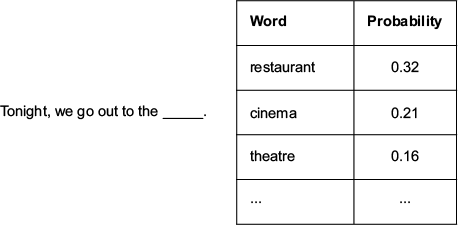
Use the context illustration to see language modeling as predicting words from surrounding textual information. section 5.1.2



