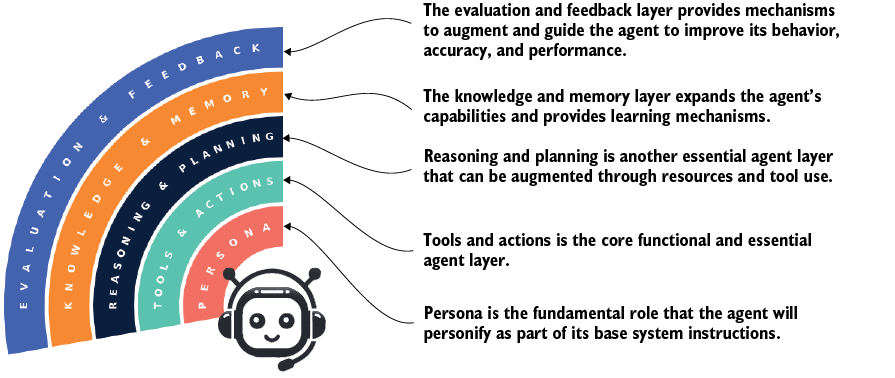
A functional layer is a distinct responsibility that adds capability to an AI agent. The five-layer model organizes persona, tools and actions, reasoning and planning, knowledge and memory, and evaluation and feedback. section 1.3
The layers describe capabilities rather than a fixed execution order:
- Persona defines the agent’s role, personality, and instructions. section 1.6
- Tools and actions let the agent interact with and manipulate external systems. section 1.6
- Reasoning and planning support complex goals, iteration, and trial-and-error. section 1.6
- Knowledge and memory provide external information and access to past experiences. section 1.6
- Evaluation and feedback improve accuracy, learning, and confidence through scoring, review, or other feedback mechanisms. section 1.6
Layers can be omitted when unnecessary, although persona, tools and actions, and reasoning and planning are generally core. During the agentic loop, reasoning consults persona, planning calls tools, tool results inform reasoning, and persona shapes communication. section 1.3
MCP across layers
Model Context Protocol can support more than tool access: GitHub, Slack, and filesystem servers support actions; sequential-thinking servers support planning; database and vector servers support knowledge and memory; and judging or approval servers support evaluation and feedback. section 3.1.5
Figure 1.6 The five functional layers of agents: persona, tools and actions, reasoning and planning, knowledge and memory, and evaluation and feedback
Use the five-layer diagram as a capability map, not as a prescribed runtime sequence. section 1.3
