A planning module reads a task representation, selects a strategy, reviews relevant experience, and constructs the plan that drives execution. Unlike a standard agent with one fixed tool-calling path, it adapts its approach to task type and complexity. section 10.2.4 section 10.2.1
Choose a strategy that matches the problem:
- Use DIRECT for simple lookups with low complexity and one tool call. section 10.2.4
- Use DECOMPOSE for multistep problems, ordering subtasks and identifying dependencies. section 10.2.4
- Use EXPLORE for ambiguity, gathering information before committing to an approach. section 10.2.4
- Use HYPOTHESIS_TEST for contradictions, generating competing explanations and tests for each. section 10.2.4
Memory improves planning without replacing it. Relevant past experiences can make a plan more efficient, while contradictory evidence should trigger replanning rather than blind adherence to the original decomposition. section 10.1.1 section 10.2.4
Diagnosing intermittent failures under load
For a contradictory troubleshooting task, the planner selects HYPOTHESIS_TEST and uses a memory about connection-pool exhaustion. It proposes tests for connection limits, health-check races, and resource contention, then lets evaluation update the next step. section 10.3.3
Figure 10.5 Planning module strategy selection
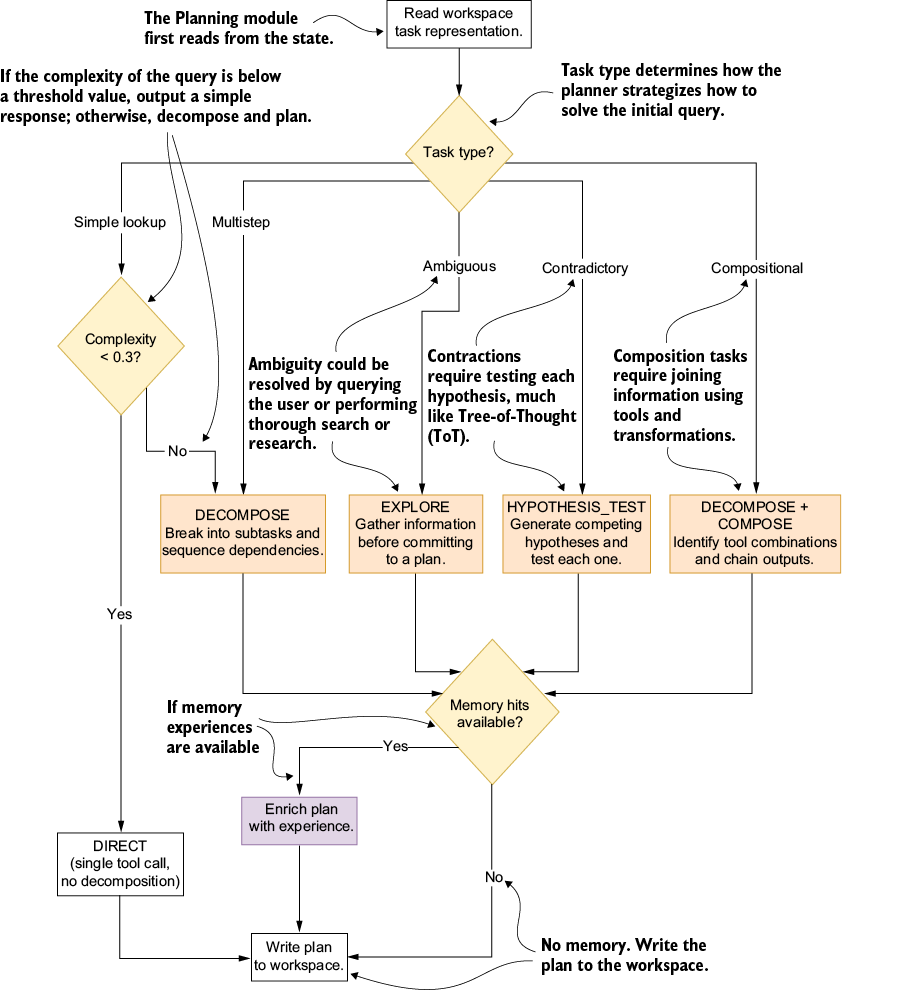
A strategy-selection decision tree makes the relationship between task type, complexity, contradictions, memory, and plan choice inspectable. section 10.2.4
