liveBook · Manning

Laser printer

As explained in How Computers Make Books

A laser printer is a printer that uses a laser to form an electrostatic image on a roller before transferring toner to paper.

A laser printer uses a laser to prepare a roller so toner adheres only where the laser shines. The toner transfers to paper and is bonded by heat. section 1.2

Millions of possible dots

At 1,200 dpi, an 8.5-by-11-inch page contains 134,640,000 possible dots, each black or white. Storing every dot would be costly, so documents are normally stored as structured paragraphs, words, letters, typefaces, lines, and curves; the dots appear temporarily during printing. section 1.2

Figure 1.5 Microscope pictures of laser-printed text
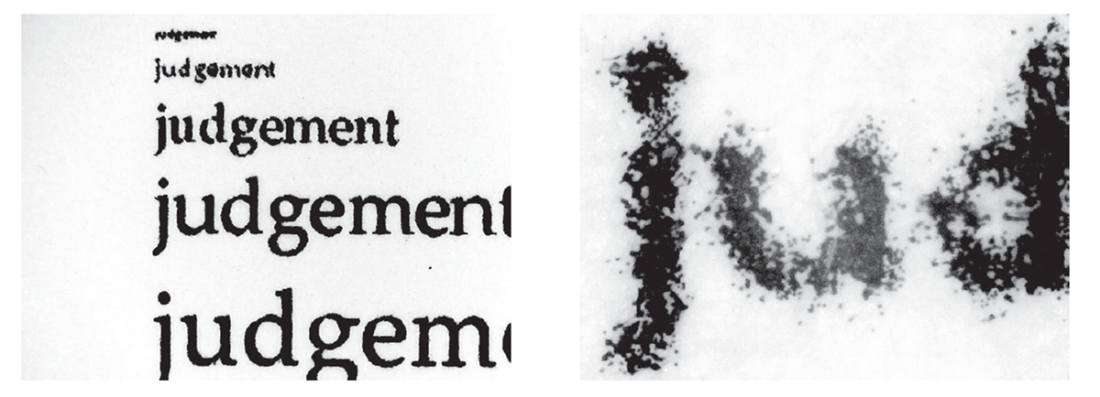
Microscope images make toner-based lettering visible at ordinary and high magnification. section 1.2
How How Computers Make Books covers it

How deep it goes
Explains the roller, toner, heat, resolution, and structured representation, without detailing printer electronics or control software.
Examples
Uses 1,200-dpi page calculations, microscope images, type sizes, and comparisons with ink-like printed lettering.
What you can do after
Evaluate how a laser printer forms marks and why documents are stored structurally rather than as millions of dots.
How it connects
Connects laser printing with toner, resolution, typography, typefaces, and rasterized dots.

Related concepts

This explainer was generated by Manning's knowledge graph from the text of How Computers Make Books. The section links point to the parts of the book it draws on.