liveBook · Manning

Toner

As explained in How Computers Make Books

Toner is the powdered coloring material transferred to paper in a laser-printing process.

Toner is the powdered coloring material used by a laser printer. A laser prepares a roller so toner adheres only to selected areas; heat then bonds it to paper. section 1.2

Under a microscope, toner particles look different from ink. The printed page may contain millions of dots, although documents are usually stored as structured text, typefaces, lines, and curves instead. section 1.2

A word under magnification

Microscope images compare laser-printed words at 1pt, 2pt, 4pt, 6pt, and 8pt, including a 400× view of the 2pt word. section 1.2

Figure 1.5 Microscope pictures of laser-printed text
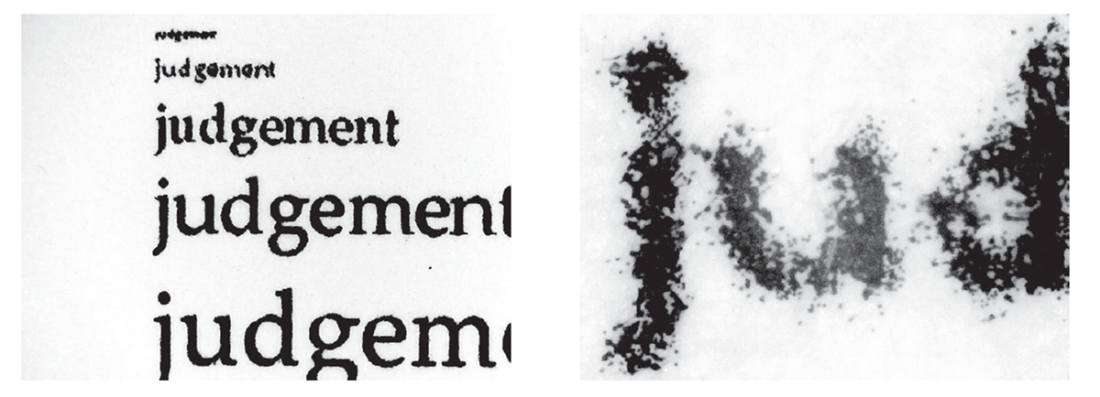
Inspecting laser-printed text makes the physical behavior of toner visible at different magnifications. section 1.2
How How Computers Make Books covers it

How deep it goes
Defines toner and sketches roller adhesion, paper transfer, and heat bonding, but stops short of printer hardware internals.
Examples
Uses microscope photographs comparing toner-based lettering, ink-like printing, resolutions, and several text sizes.
What you can do after
Evaluate how toner forms printed lettering and why pages are stored structurally rather than as millions of dots.
How it connects
Connects toner with laser printing, ink, paper, dots, typefaces, and structured document representation.

Related concepts

This explainer was generated by Manning's knowledge graph from the text of How Computers Make Books. The section links point to the parts of the book it draws on.