liveBook · Manning

Last usable address

As explained in Acing the CCNA Exam: Volume 1 Fundamentals and Protocols

The last usable address is the IPv4 address immediately before the broadcast address that can be assigned to a host.

The last usable address is the final IPv4 address that can be assigned to a host in a network or subnet. It is immediately before the broadcast address; the broadcast address itself cannot be assigned to a host. section 7.3.3 section 11.2.1

Find the last usable address with this practical sequence:

  • Identify the subnet’s broadcast address, whose host portion contains all 1s. section 7.3.3
  • Subtract 1 from the broadcast address; this produces the last address available for host assignment. section 11.2.1
  • Remember that the network address and broadcast address are excluded, so the maximum host count is 2ᵞ − 2. section 7.3.3

Example: 192.168.1.64/26

The subnet’s broadcast address is 192.168.1.127. Subtracting 1 gives 192.168.1.126, the last usable address. The first usable address is 192.168.1.65, and the subnet supports 62 hosts. section 11.2.1

Figure 7.15 192.168.100.254 is the last usable address of the 192.168.100.0/24 network. It is the last address before the broadcast address.
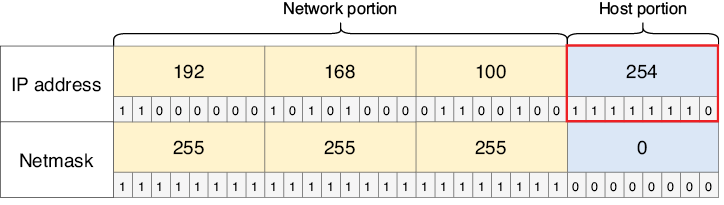
Use the figure to compare the last usable address with the broadcast address in a /24 network. section 7.3.3

How Acing the CCNA Exam: Volume 1 Fundamentals and Protocols covers it

How deep it goes
Explains the definition and subtraction method, then works through /24 and /26 examples without addressing special /31 handling.
Examples
Uses 192.168.100.0/24 and 192.168.1.64/26 to demonstrate broadcast subtraction and host-range boundaries.
What it assumes
Assumes familiarity with IPv4 addresses and prefix lengths while defining network, broadcast, and host portions.
What you can do after
Apply it via subnetting calculations to determine the highest assignable host address in an IPv4 subnet.
How it connects
Connects the last usable address to network address, broadcast address, first usable address, subnetting, and maximum number of hosts.

Related concepts

This explainer was generated by Manning's knowledge graph from the text of Acing the CCNA Exam: Volume 1 Fundamentals and Protocols. The section links point to the parts of the book it draws on.