A latest start time (LS) is the latest point at which an activity can begin without delaying the project’s completion. It is determined during a backward pass through the project network. section 13.3 section 13.3.2
Calculate and interpret LS values as follows:
- Set the final activity’s latest finish time to the planned project completion time. section 13.3.2
- Subtract the activity duration from its latest finish time: LS = LF − duration. section 13.3.2
- For an activity with multiple successors, use the smallest successor latest start time as its latest finish time. section 13.3.2
- Compare LS with earliest start time to calculate slack; zero slack identifies a critical-path activity. section 13.3.3
Automated reporting tool project
The project finishes at week 29. Activity L has a two-week duration, so its latest start time is 29 − 2 = 27 weeks. Activity K must finish when L starts, at week 27; with a three-week duration, K has an LS of 24 weeks. section 13.3.2
Figure 13.3 A second visual representation of the automated reporting tool project plan. The new three-digit sequence for each activity represents, in order, the latest start time, the expected duration, and the latest finish time. A quick and easy way of distinguishing critical tasks from noncritical tasks is to compare the three-digit sequences: critical tasks have similar three-digit sequences, whereas noncritical tasks do not.
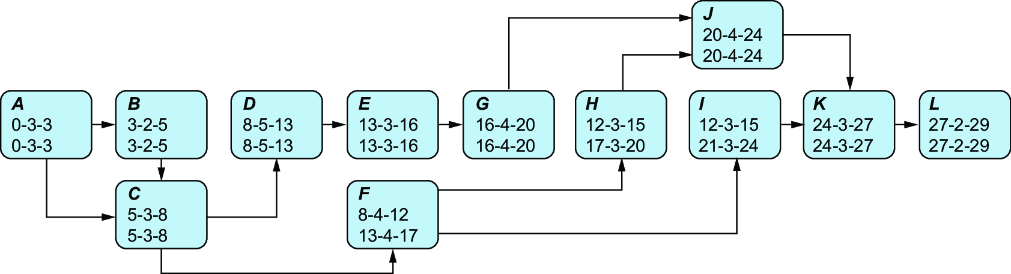
Compare each activity’s latest-start, duration, and latest-finish sequence to distinguish critical tasks from noncritical tasks. section 13.3.2
