A Layer 3 switch, also called a multilayer switch, combines switching with packet routing. It commonly performs inter-VLAN routing without requiring an external router. section 12.4.2 section 12.5
Understand its main operating pieces:
- Uses switch virtual interfaces (SVIs), such as interface vlan 10, as Layer 3 gateways for VLAN hosts. section 12.4.2
- Requires ip routing before it can forward packets between VLANs or subnets. section 12.4.2
- Can convert a physical switch port into a routed port with no switchport, then assign it an IP address. section 12.4.2
- Removes the need for an external router when SVIs provide all required inter-VLAN routing. section 12.4.2
Configure SVIs for inter-VLAN routing
SW1(config)# ip routing SW1(config)# interface vlan 10 SW1(config-if)# ip address 172.16.1.1 255.255.255.192 SW1(config)# interface vlan 20 SW1(config-if)# ip address 172.16.1.65 255.255.255.192 These commands enable routing and assign gateway addresses to VLAN 10 and VLAN 20. Verify the result with show ip interface brief and show ip route; the SVIs should appear up/up with connected routes. section 12.4.2
Figure 12.11 SW1, a multilayer switch, routes a packet from PC1 to PC5. SW1 has three SVIs: VLAN 10 (172.16.1.1), VLAN 20 (172.16.1.65), and VLAN 30 (172.16.1.129), allowing SW1 to route packets internally, without relying on an external router.
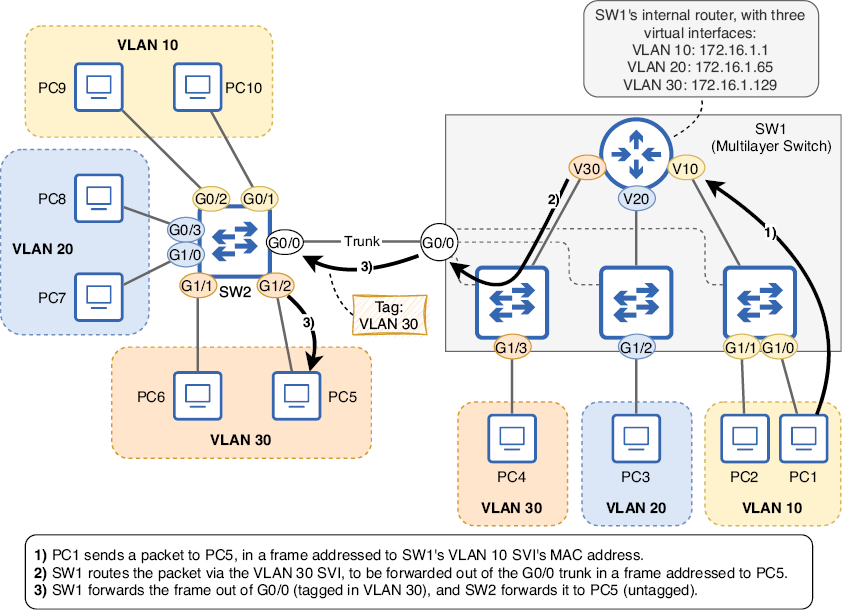
Trace a packet moving from PC1 in VLAN 10 to PC5 in VLAN 30. The switch receives the frame at the VLAN 10 SVI, routes internally, and forwards a new VLAN 30 frame toward PC5. section 12.4.2
