A leaf node is the endpoint of a decision tree. Unlike a root or internal node, it has no further split: it supplies the predicted class for classification or a continuous value for regression. To interpret a prediction, begin at the root, follow the feature condition at each decision node, and read the result at the leaf reached. section 6.3.6 section 6.3
During training, a tree selects splits that separate classes or reduce variation in a continuous target. Growth ends when a stopping criterion is met, such as maximum depth or a minimum number of samples per leaf. A reached leaf is therefore the end of the model’s decision path, not another question to answer. section 6.1 section 6.3.6
Reading a classification path
For a fourth-down conversion attempt, a tree first tests whether TO_GO is at most 3.5. Follow the branch matching the play, then continue through any conditions on PLAY_TYPE or SCORE_DIFFERENTIAL until a leaf predicts success or failure. The first split alone is not necessarily a leaf: training-data counts on its two sides are 268 successes versus 127 failures and 67 successes versus 156 failures, respectively, but later splits can refine either group. section 6.3.6
Figure 6.10 A closer look at the left subtree: two levels of internal nodes (A) and, at the bottom, four leaf nodes (B). When PLAY_TYPE is 0, thereby indicating a running play, the decision tree predicts a successful fourth-down conversion attempt (a); it doesn’t matter if the team on offense is the road or home team. Alternatively, when PLAY_TYPE is 1, indicating a passing play, the decision tree evaluates SCORE_DIFFERENTIAL before making a prediction. If the team on offense is trailing by 22 points or more, the tree predicts a failed fourth-down conversion attempt (b); but if the team on offense is trailing by fewer than 22 points, the decision tree predicts a successful conversion (c).
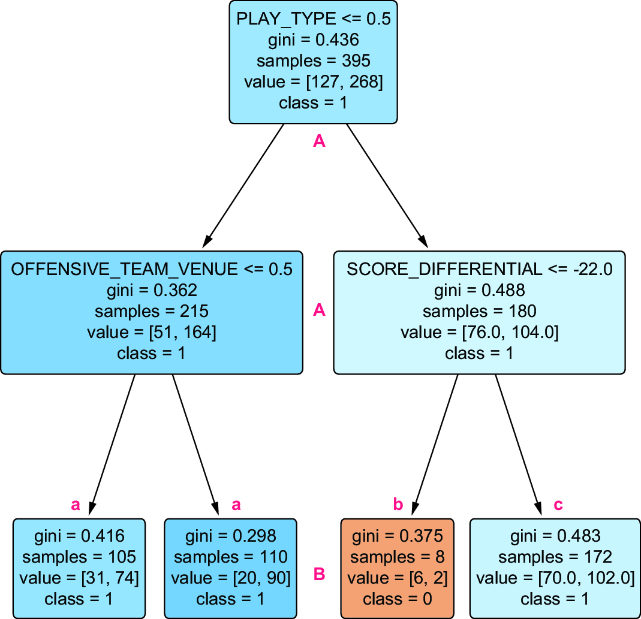
The left subtree shows how successive conditions end at different leaf predictions for fourth-down conversions. section 6.3.6
A single leaf prediction does not establish how well the tree generalizes. Evaluate classification results against held-out labels using overall accuracy and a confusion matrix. In a random forest, individual trees also reach leaves, but their predictions are aggregated rather than used alone. section 6.5 section 6.0









