Learning with errors (LWE) hides a secret vector inside many linear equations. Each equation combines a random vector with the secret, then adds a small random error, usually modulo a large number. Without the errors, Gaussian elimination can recover the secret efficiently; with larger numbers and more secret coordinates, recovery becomes hard. section 14.3.2
From solvable equations to noisy equations
The clean equations 5s₀ + 2s₁ = 27 and 2s₀ = 6 reveal s₀ and s₁ through Gaussian elimination. Changing their results to 28 and 5 introduces noise, making the secret harder to determine. In vector form, random aᵢ and secret s produce aᵢs + eᵢ, where eᵢ is small random error. For example, s = (3, 6), a₀ = (5, 2), and a₁ = (2, 0) produce the original equations through dot products. section 14.3.2
The construction is commonly organized as follows:
- Choose a secret vector whose coordinates are considered modulo a large number. section 14.3.2
- Generate random vectors and publish their noisy dot products with the secret. section 14.3.2
- Rewrite the equations as t = As + e, where A contains the random vectors and e contains the errors. section 14.3.3
- Use small errors and private-key coefficients relative to q; this structure supports LWE-based encryption and key exchange such as Kyber. section 14.3.3
Figure 14.9 The learning with errors problem (LWE) is said to be a lattice-based construction due to the existence of a reduction to a lattice problem: the CVP. In other words, if we can find a solution to the CVP, then we can find a solution to the LWE problem.
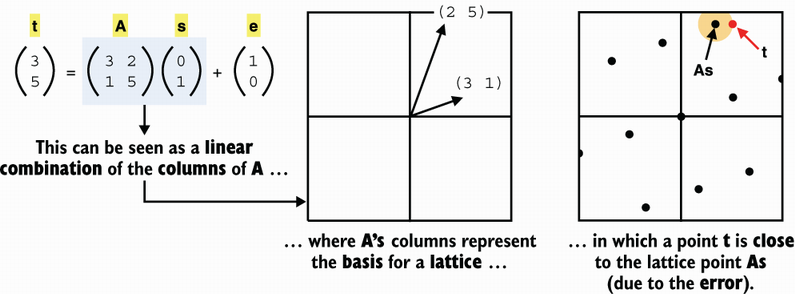
Relate LWE to a lattice problem through a reduction to the closest vector problem (CVP). section 14.3.2
