Cost per iteration (CPI) measures the resources consumed by one agent development loop: model tokens, CI time, and developer attention. Treating token spend as the whole cost hides the largest variable: people reviewing agent output. section 10.3.3 section 10.3.6
Track CPI as a combined operational cost rather than a single invoice:
- Compress the build portion with remote caching, incremental builds, and shared artifacts; one agent's compilation can become another agent's cache hit. section 10.3.3
- Keep verification separate: cache hits accelerate execution, but selecting the tests required for a change still demands engineering judgment. section 10.3.3
- Include review overhead, because senior engineers reading Yellow and Red agent output can outweigh licenses, infrastructure, and tokens combined. section 10.3.6
A falling CPI in a monorepo
A team targeted CPI below $0.50. Without remote caching, iterations cost about $1.20; after cache warming and broader agent participation, CPI fell from $0.95 to $0.31 over six weeks. The result demonstrates a team-scale effect: adding agents can reduce each agent's build cost, while review and verification remain separate cost centers. section 10.7.1 section 10.3.3
Figure 10.4 Remote caching: Shared cache gets warmer as more agents run.
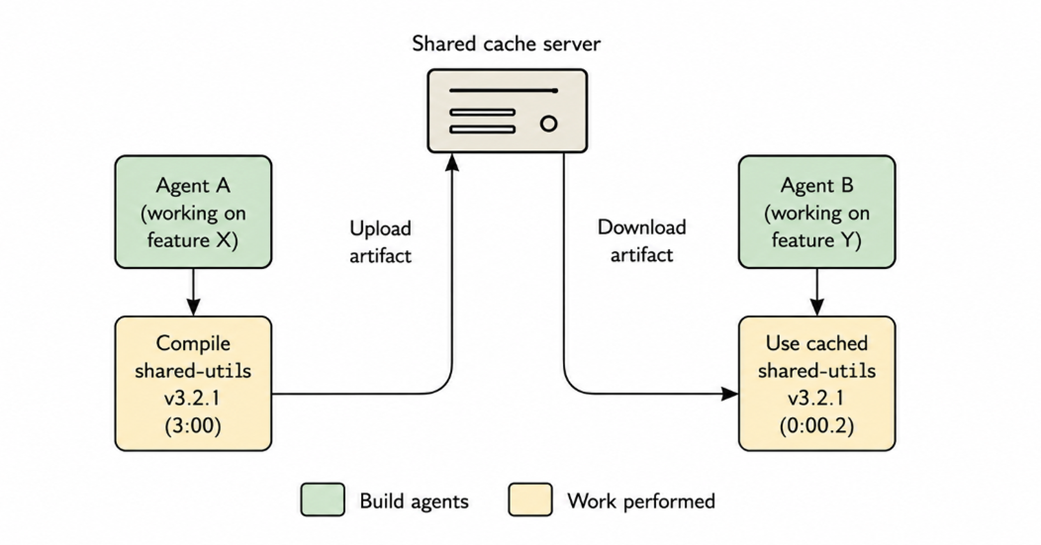
Use the shared-cache diagram to see why additional agents can warm a common build cache and lower subsequent iteration costs. section 10.3.3
