liveBook · Manning

LeNet

As explained in Distributed Machine Learning Patterns

LeNet is a convolutional neural network architecture originally designed for handwritten-digit recognition.

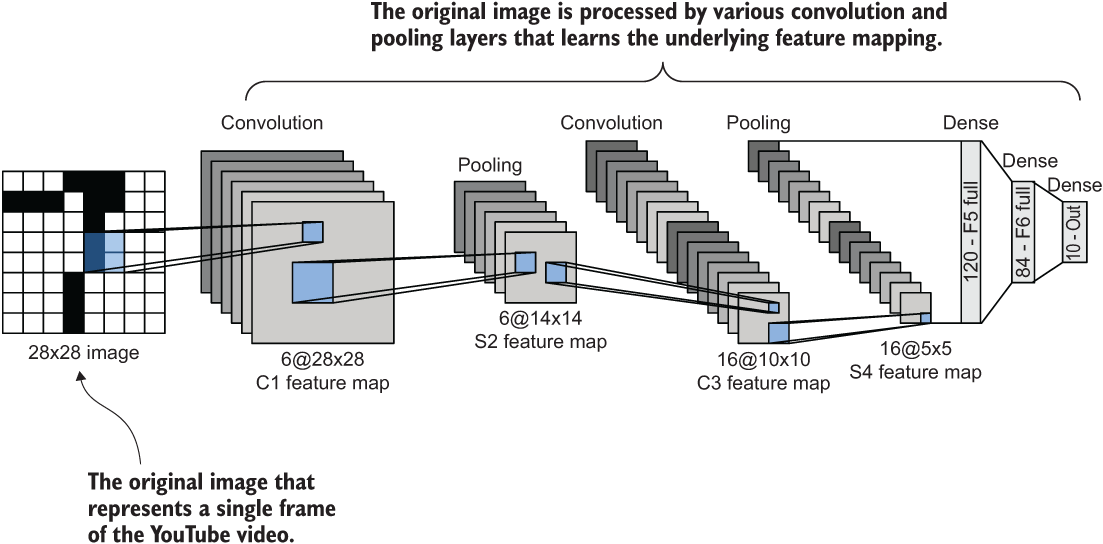
LeNet is a convolutional neural network for image classification, originally designed to recognize handwritten digits. Its architecture combines a convolutional encoder with two convolutional layers and a dense block with three fully connected layers. section 3.2.2

A simplified LeNet workflow includes:

  • Process each video frame as a 28 × 28 image. section 3.2.2
  • Learn feature mappings through convolutional and pooling layers. section 3.2.2
  • Use fully connected layers to classify examples into one of ten selected entities. section 3.2.2
Figure 3.6 LeNet model architecture that could be used to classify new YouTube videos in 1 of 10 selected entities. (Source: Aston Zhang et al. Licensed under Creative Commons Attribution-ShareAlike 4.0 International Public License)
03-06

The architecture diagram shows how LeNet can classify new YouTube videos into one of ten selected entities. section 3.2.2


How Distributed Machine Learning Patterns covers it

How deep it goes
Explains the two-part architecture and input processing, but stops short of layer-specific dimensions or training procedures.
Examples
Uses handwritten-digit recognition and 28 × 28 video frames classified into ten selected entities.
What you can do after
Evaluate/understand a compact CNN architecture for image and frame classification.
How it connects
Connects convolutional neural networks with pooling layers, fully connected layers, backpropagation, and support vector machines.

Also explained in

Compare how 3 books explain LeNet →

Related concepts

This explainer was generated by Manning's knowledge graph from the text of Distributed Machine Learning Patterns. The section links point to the parts of the book it draws on.
