LeNet is a convolutional neural network for handwritten-digit classification. Its architecture repeatedly applies convolution, ReLU activation, and max-pooling, increasing feature counts while reducing feature-map dimensions. section 10.2.1
The stack ends by flattening the feature map, passing it through a dense layer, and applying a softmax classifier. This design learns progressively richer visual features before producing digit-class probabilities. section 10.2.1
A practical LeNet workflow includes:
- Load MNIST and reshape images to the required image dimensions. section 10.2.1
- Define training parameters and stack convolutional, ReLU, and max-pooling layers. section 10.2.1
- Compile and train the model with callbacks, record training history, and evaluate it on test data. section 10.2.1
- Inspect loss and accuracy curves, use early stopping when validation loss stops improving, and save predictions. section 10.2.1
Figure 10.4 LeNet architecture for MNIST digits classification
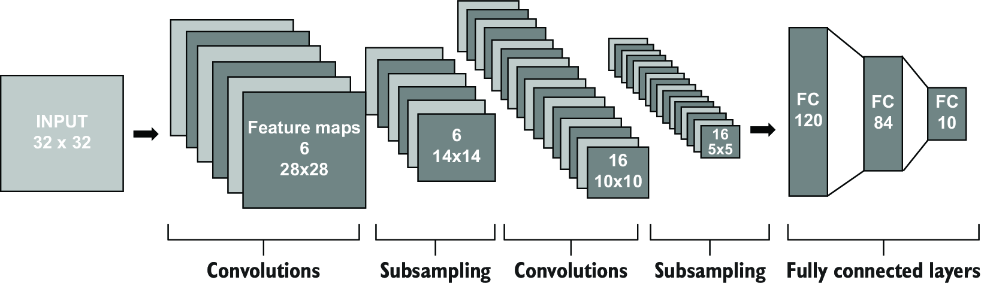
Use the architecture figure to trace the progression from image input through convolution, activation, pooling, and final classification. section 10.2.1
MNIST digit classification
A Keras/TensorFlow implementation trains a simple LeNet-style CNN on MNIST and achieves about 99% test accuracy, with training and validation plots used to inspect learning behavior. section 10.2.1


