Ligand-based machine learning trains a model to relate molecular structural features to observed compound activity. With known active and inactive compounds, it can discriminate between the classes and predict activity for new compounds. These activity-prediction models are sometimes called quantitative structure–activity relationship (QSAR) models, although not every QSAR model uses machine learning; quantitative structure–property relationship (QSPR) is the broader term. section 2.1.1
Use ligand-based machine learning when:
- Both positive and negative examples are available; with only known actives, similarity or pharmacophore searching is more appropriate. section 2.1.1
- A virtual-screening workflow needs a learned activity filter before more intensive downstream methods. section 2.1.1
Figure 2.2 Regarding ligand-based strategies, machine learning becomes available if we have examples of both positive class and negative class compounds within our data. If we only have examples of positive class compounds, then search based strategies are more appropriate. Positive class means the compound is “positive” for the property we are assessing whether it be activity, toxicity, or some other property.
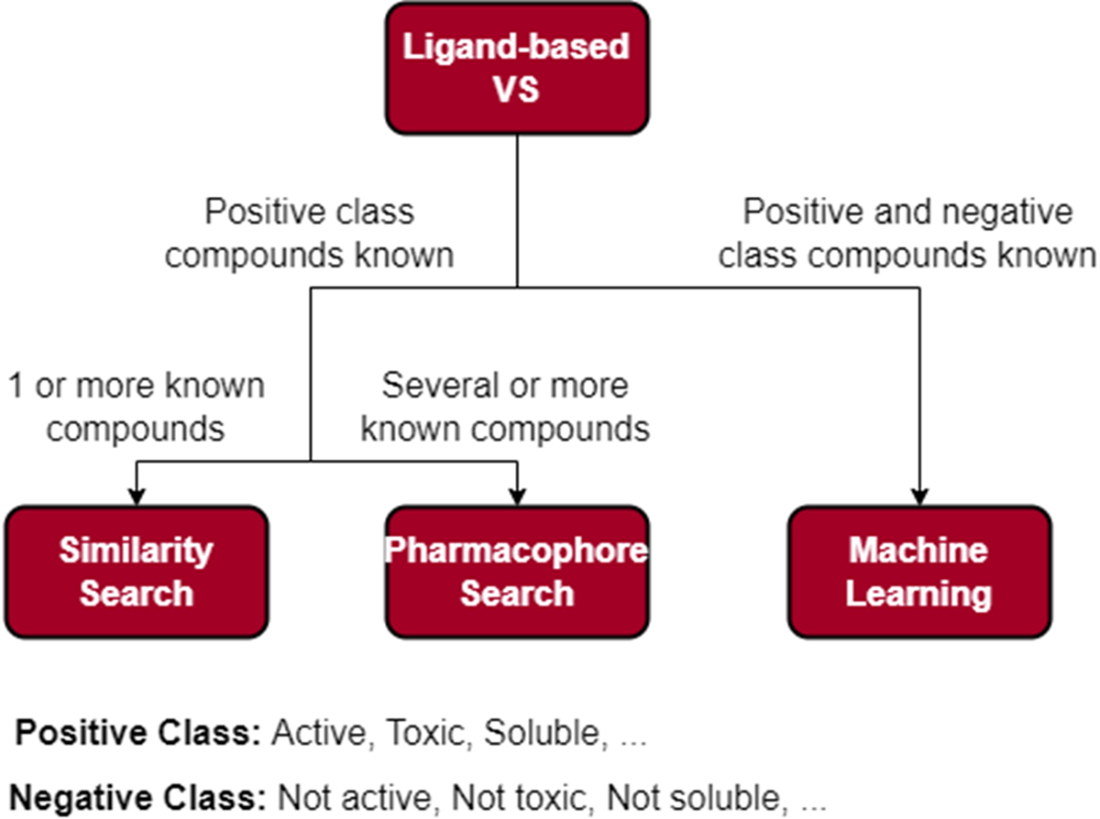
The decision diagram clarifies when ligand-based machine learning becomes appropriate and contrasts it with search-based strategies. section 2.1.1
