A likelihood measures how compatible observed data are with a proposed hypothesis or parameter value. In Bayesian reasoning, it combines with a prior belief to produce a posterior belief. section 2.1 section 3.1
The same observation can affect beliefs differently depending on the hypothesis. A correct guess has likelihood 1 if the person is psychic, but likelihood 1/10 if the guess is random. section 3.1
A Bayesian update using likelihood proceeds by:
- Starting with a prior probability for the hypothesis. section 3.1
- Computing how likely the observed result is under competing hypotheses. section 3.1
- Combining the prior and likelihood terms to obtain a posterior, then using that posterior as the next prior when observations repeat. section 3.1
House prices
An observed price for a nearby, similar house can substantially narrow the belief about your own house’s price, whereas an unrelated house leaves that belief unchanged. section 2.1
Repeated successful guesses
After 100 successful guesses, posterior belief in psychic ability increases or stays flat; its rate of increase depends on the initial prior. section 3.1
Figure 2.2 Bayes' theorem, which gives a method of updating a belief about a quantity of interest, represented as a probability distribution of a random variable. Before observing any data, we have the prior belief about X. After being updated with data, we obtain the posterior belief about X.
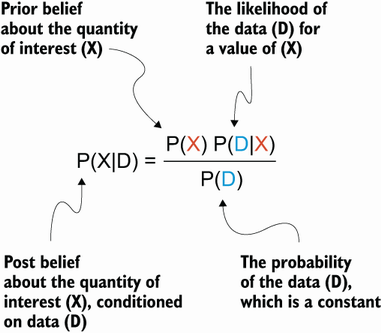
Visualizes the transition from a prior belief to a posterior belief after incorporating observed data. section 2.1




