LIME explains one prediction at a time by approximating a complex model’s local decision boundary with a simpler, interpretable model such as linear regression. It answers why a particular input received its prediction, rather than describing the model’s overall behavior. section 11.2.1
Use LIME pragmatically when investigating model behavior or deciding which features to retain:
- Estimate each feature’s contribution to a specific prediction. section 11.2.1
- Measure feature contribution alongside SHAP, shuffle importance, and built-in importance measures rather than treating one method as definitive. section 11.2.1 section 11.5.1
- Drop features that contribute little to the model’s outcome, while checking ranges, outliers, correlations, and computational cost in the training pipeline. section 11.5.1
Retail demand features
For a supermarket demand model, LIME can help assess whether a prediction reflects a promo calendar, discount, store traffic, SKU history, or other candidate feature. That evidence supports feature-selection decisions, but does not replace broader model evaluation. section 11.5.1
Figure 11.3 A taxonomy of model explanation methods
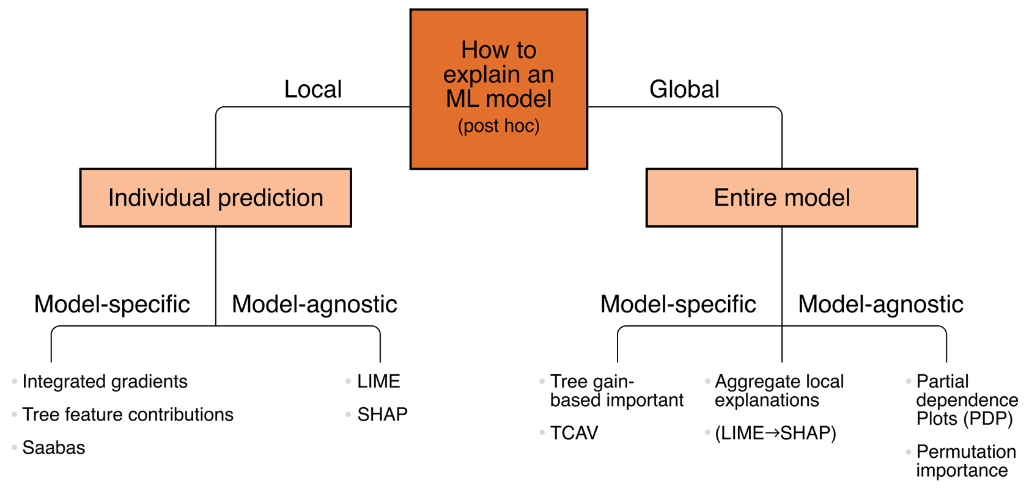
Use the taxonomy to distinguish LIME’s local, individual-prediction role from methods that interpret the entire model. section 11.2.1


