A line segment is the finite straight connection between two points. In a coordinate drawing, its endpoints can define it: (1, 1)—(6, 3). Reversing the endpoints describes the same segment. Although ordinary mathematics reserves “line” for an infinite length, drawing discussions may use “line” informally for a segment. section 1.3
On paper or a screen, a segment becomes a pattern of dots. A shallow segment is approximated by choosing a nearby dot in each column; a steep one works better with one dot in each row. Higher resolution and gray shades make the result look smoother. section 1.3
Line segments become useful building blocks because:
- Joining several segments creates polygons and more elaborate outlines. section 1.4
- A coordinate sequence can describe an outline, which can then be converted from vector graphics into colored raster dots. section 1.4
A square from four segments
The segments (1, 1)—(10, 1), (10, 1)—(10, 10), (10, 10)—(1, 10), and (1, 10)—(1, 1) form a square. Writing the endpoints in sequence gives a compact description of the outline. section 1.4
Figure 1.6 A line defined by the coordinates of its two endpoints
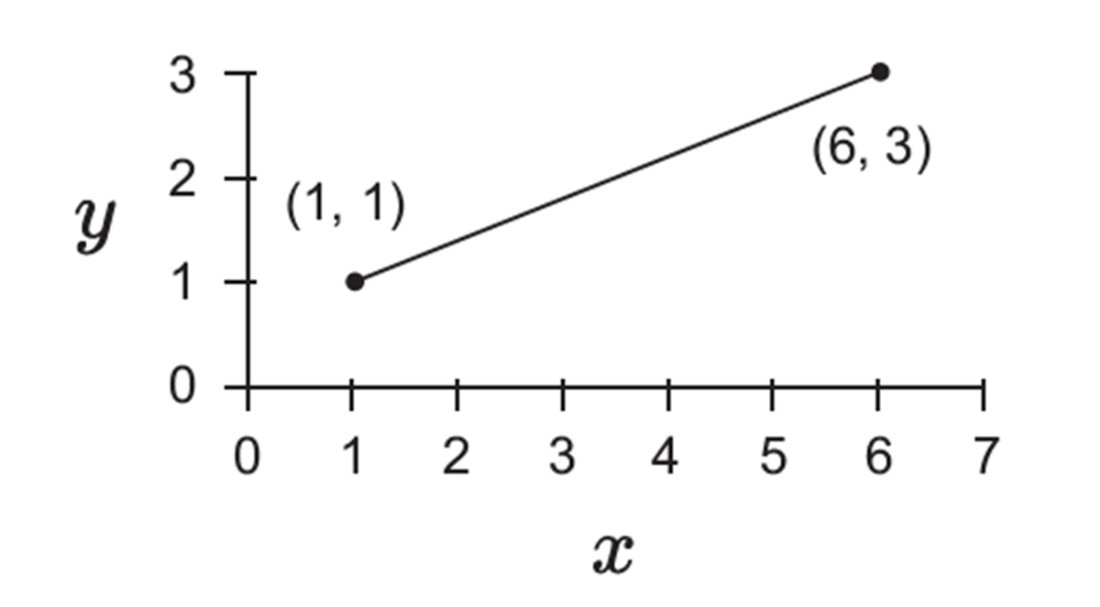
Use the endpoint-coordinate figure to see how a segment is specified before it is approximated with screen or paper dots. section 1.3



