Linear blending combines predictions from different models into one ensemble output. Its practical appeal became clear during the Netflix Prize, where teams combined many diverse models to improve accuracy. section 3.0 section 1.0
The intuition is straightforward: let several independently trained models contribute according to performance-based weights, then add their outputs as a weighted linear combination. Unlike bagging and random forests, linear blending gains diversity from different learning algorithms rather than only from resampling. section 3.0
A practical blending workflow is:
- Select diverse base learners, such as a decision tree, support vector machine, or artificial neural network. section 3.0
- Train the base estimators independently, including models that may already have been trained elsewhere. section 3.0
- Assign weights based on model performance and combine the resulting predictions linearly. section 3.0
Netflix Prize
Early Netflix Prize systems used models with different parameterizations and a linear blend. As the competition evolved, teams replaced the linear blend with a nonlinear one, illustrating both the usefulness and the limits of linear combination. section 1.0
Figure 3.1 Homogeneous ensembles (chapter 2), such as bagging and random forests, use the same learning algorithm to train base estimators, and they achieve ensemble diversity through random sampling. Heterogeneous ensembles (this chapter) use different learning algorithms to achieve ensemble diversity.
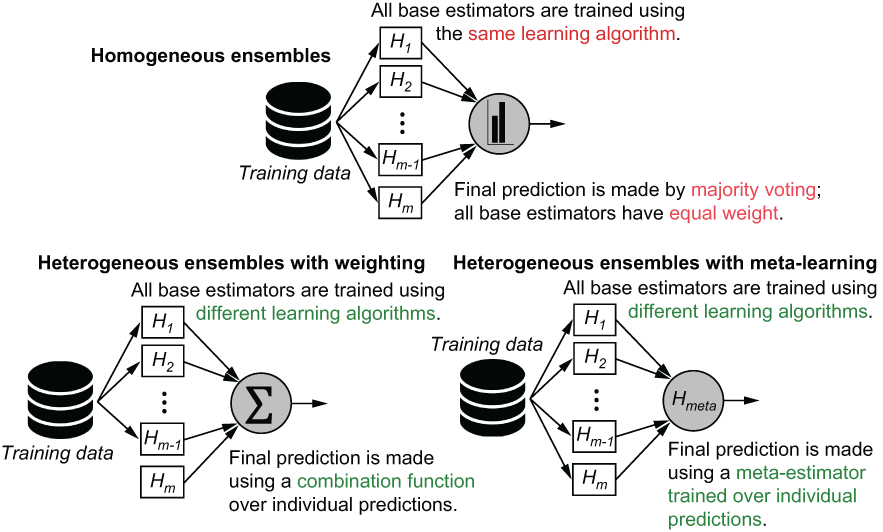
Compare linear blending’s heterogeneous model diversity with homogeneous ensembles such as bagging and random forests. section 3.0
