Meta-learning combines different models by learning how to use their predictions. Instead of hand-designing weights or another fixed rule, it treats base-estimator predictions as metadata and feeds them to a second-level learner. section 3.0 section 3.3
A simple stacking workflow is:
- Train diverse base estimators, using different learning algorithms to create heterogeneous predictions. section 3.5
- Use their predictions as inputs to a meta-estimator, which learns the combination function from data. section 3.3
- Use cross-validation to reduce overfitting, or use a single validation set for the faster blending procedure. section 3.5
Stacking in recommendation
Stacking became prominent in recommendation systems after top teams used it during the Netflix Prize competition. The same approach has also been applied to chemometrics, text classification, and spam filtering. section 3.3
Figure 3.1 Homogeneous ensembles (chapter 2), such as bagging and random forests, use the same learning algorithm to train base estimators, and they achieve ensemble diversity through random sampling. Heterogeneous ensembles (this chapter) use different learning algorithms to achieve ensemble diversity.
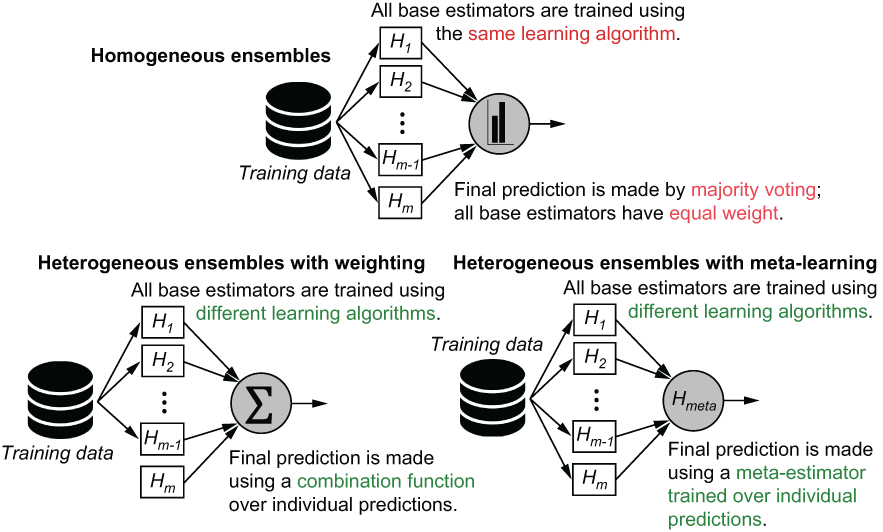
Compare fixed weighting with learned prediction combination, and distinguish homogeneous ensembles from heterogeneous ensembles. section 3.0
