A heterogeneous ensemble combines independently trained models that use different learning algorithms. Think of several specialists reaching a diagnosis: a decision tree, SVM, and neural network can disagree in useful ways, then contribute to one final prediction. Unlike homogeneous ensembles, which create diversity through random sampling with one algorithm, heterogeneous ensembles create it by varying the algorithms themselves. section 2.1 section 3.0
Figure 3.1 Homogeneous ensembles (chapter 2), such as bagging and random forests, use the same learning algorithm to train base estimators, and they achieve ensemble diversity through random sampling. Heterogeneous ensembles (this chapter) use different learning algorithms to achieve ensemble diversity.
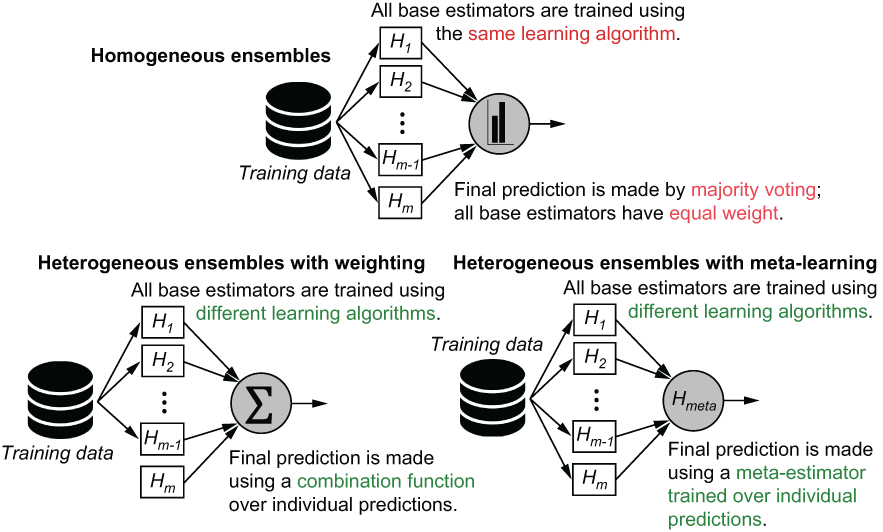
Compare the two routes to diversity: resampling for homogeneous ensembles versus different learning algorithms for heterogeneous ensembles. section 3.0
The workflow has two parts: fit each base estimator separately, then aggregate its predictions. For classification, aggregation can use hard class labels or soft prediction probabilities; probabilities typically give smoother output. Better models may receive larger performance-based weights, or a learned meta-estimator can determine how to combine model outputs. section 3.1.2 section 3.5
Common ways to combine diverse models include:
- Weighted combination—assign each base estimator a weight based on performance, then use a predefined function such as a weighted sum. section 3.5
- Stacking—train first-level estimators, then train a second-level meta-estimator on their outputs. section 3.5
- Blending—use one validation split to generate meta-features for the second-level estimator instead of cross-validation. section 3.4.3
- Regression aggregation—combine continuous predictions with mean, median, minimum, or maximum; median can reduce an outlier prediction's influence. section 7.2.2
Blending text classifiers
Split training data into training and validation portions. Fit a random forest, Extra Trees, logistic regression, Bernoulli naïve Bayes, and linear SVM on the training portion. Their validation predictions become five meta-features, appended to the original features, for a neural-network meta-estimator. Mixing linear and nonlinear classifiers supplies the intended diversity. section 3.4.3
Diversity alone does not guarantee improvement. Complex nonlinear combination functions and stacking can overfit, especially with noisy data. Cross-validation reduces this risk by separating the data used for base-model and meta-model predictions, but increases training time; blending is a faster validation-set alternative. section 3.5
