A parallel ensemble trains multiple base models independently, then combines their predictions into one answer. Like a diagnostician consulting independent residents, it benefits from diverse opinions and aggregation. section 2.1 section 1.5
A parallel ensemble typically follows this pattern:
- Choose a base-learning algorithm or a collection of different algorithms. section 1.5
- Train each base estimator independently, allowing training to occur in parallel. section 2.0
- Create diversity by randomly subsampling training examples, features, or both, or by changing the learning algorithm. section 2.0 section 7.2
- Aggregate the individual predictions into a final classification or regression prediction. section 2.1 section 7.2
Homogeneous parallel ensembles use the same learning algorithm for every base model; bagging, random forests, and Extra Trees are examples. Heterogeneous ensembles use different algorithms, as in stacking. Parallel ensembles often use strong learners, unlike sequential ensembles, which commonly build strong models from dependent weak learners. section 1.5 section 7.2
Regression with random forests
For bike-rental prediction, RandomForestRegressor and ExtraTreesRegressor can be tuned by exhaustive grid search and cross-validation. Useful hyperparameters include ensemble size and maximum base-estimator depth; candidate loss functions include squared error and Poisson. section 7.4.3
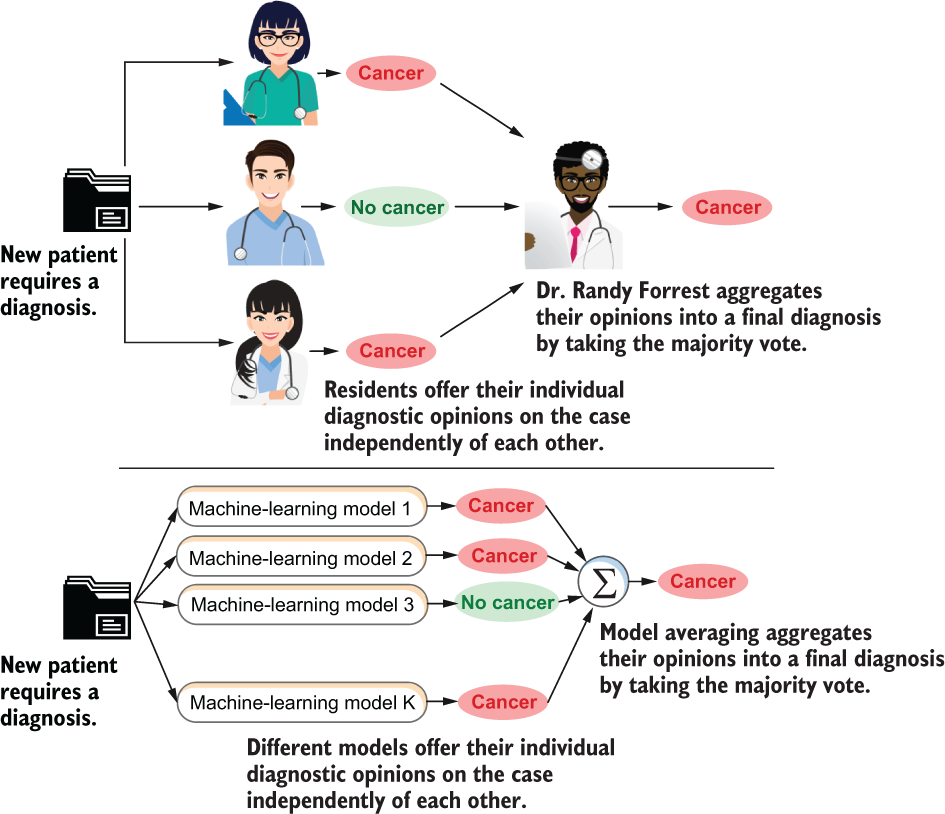
Use the diagnostic analogy to visualize independent base estimators contributing opinions that are combined into one prediction. section 2.1
