A homogeneous ensemble is a parallel ensemble whose base learners all use the same learning algorithm, such as decision trees. Rather than asking different model types for opinions, it trains independent versions of one model type and combines their predictions. Because the learners are independent, they can be trained in parallel. section 2.0 section 1.5
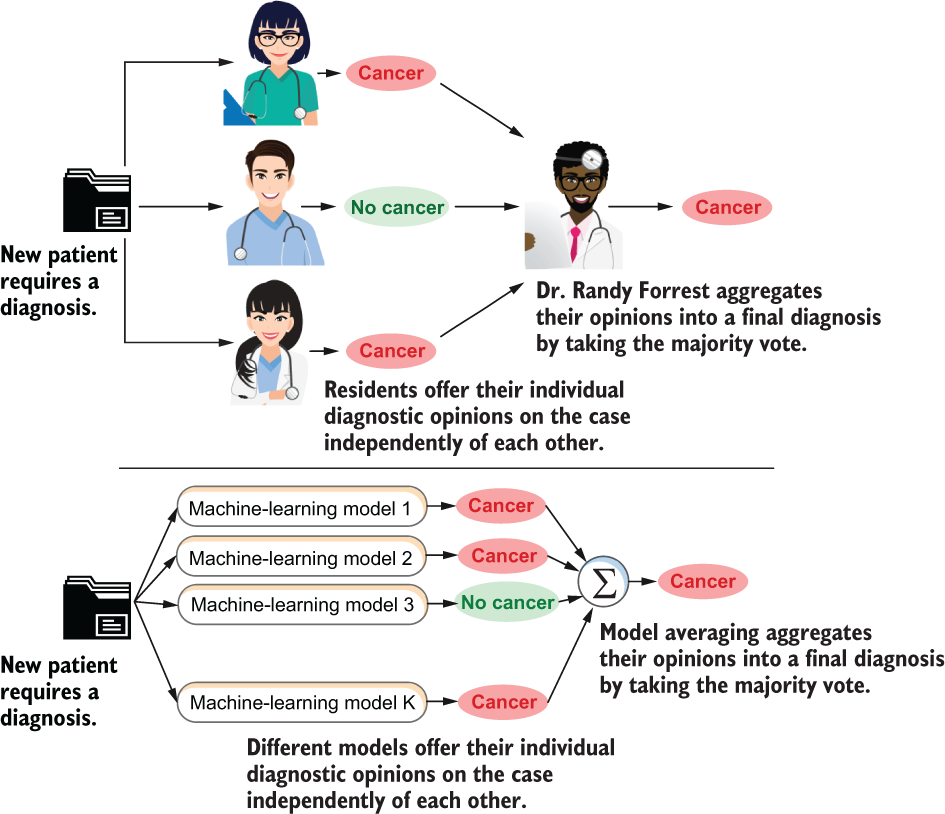
Like several residents independently assessing a diagnosis, base learners contribute separate opinions that are combined into one decision. The central design problems are creating diverse opinions and choosing an aggregation rule. section 2.1
Using one algorithm does not mean producing identical models. Diversity comes from randomization: sample training examples, features, or both differently for each learner. The ensemble then aggregates the resulting predictions. For classification, this can be majority voting; for regression, it is commonly the mean prediction. section 2.0 section 7.2.1
Common homogeneous parallel methods vary mainly in where they introduce randomness:
- Bagging draws bootstrap samples—samples with replacement—from the training data, fits a base estimator to each sample, and aggregates their predictions. section 2.6
- Random forests are bagging ensembles of randomized decision trees, which evaluate a random subset of features when selecting splits. section 7.2.1
- Extra Trees add stronger tree randomization by selecting both split variables and split thresholds randomly; they do not use bootstrap sampling. section 2.6 section 7.2.1
- Pasting samples examples without replacement; random subspaces sample features; random patches sample both examples and features. section 2.6
These methods are especially suited to unstable, high-complexity or nonlinear estimators, where randomized training can yield meaningfully different fitted models. More diversity can reduce variability and smooth predictions, but every fully trained learner adds computational cost even when training is parallelized. section 2.6 section 7.2.1
Diagnosis and fuel-efficiency prediction
For breast-cancer classification, compare bagged decision trees, random forests, and Extra Trees on the Wisconsin Diagnostic Breast Cancer data. For AutoMPG regression, fit random-forest and Extra-Trees regressors to engine attributes and evaluate predictions after centering and rescaling features. section 2.5 section 7.2 section 7.2.1
