A sequential ensemble turns several modest models into a stronger predictor by training them in stages. Each new model depends on the previous model and concentrates on reducing its mistakes, unlike parallel ensembles whose models are trained independently. section 1.5 section 4.1
Think of weak learners as amateurs who are each slightly better than guessing. Sequential training lets the next amateur focus on the cases earlier learners handled poorly, gradually combining their limited strengths into one strong learner. section 4.1
A typical sequential ensemble proceeds stage by stage:
- Start with a simple base estimator, often a decision stump or shallow tree. section 4.1
- Train the current estimator using information about errors from the preceding estimator. section 1.5 section 7.3
- Repeat the process so later estimators improve the ensemble’s previous predictions. section 7.3
- Combine the learners into a stronger final predictor rather than relying on one complex model. section 4.1
Classification and regression
AdaBoost adapts later learners to classification mistakes, while gradient and Newton boosting train shallow regression trees against residuals. Residual magnitude identifies large errors; its sign indicates whether predictions should increase or decrease. section 4.2 section 7.3
Figure 4.1 Differences between parallel and sequential ensembles: (1) base estimators in parallel ensembles are trained independently of each other, while in sequential ensembles, they are trained to improve on the predictions of the previous base estimator; (2) sequential ensembles typically use weak learners as base estimators.
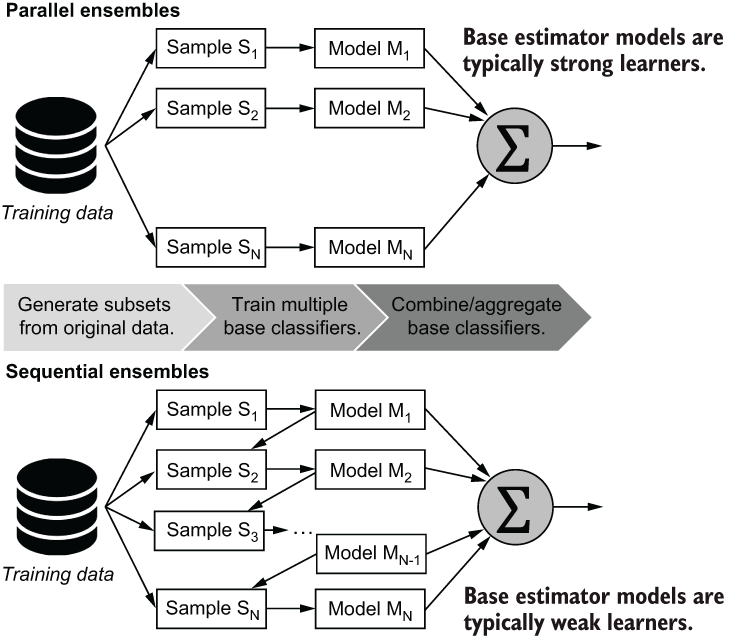
Compare independent parallel training with dependent sequential training, including the typical use of strong versus weak learners. section 4.1
