liveBook · Manning

Linear transformation

As explained in Applied Reinforcement Learning

A linear transformation maps inputs to weighted combinations of those inputs, possibly with an added bias.

A linear transformation combines inputs through a weighted sum and adds a bias. In a neural network layer, this operation is followed by a nonlinear activation, which lets the network model relationships that stacked linear transformations alone cannot capture. section 8.2

Figure 8.5 The building block of deep networks: neurons and activation functions
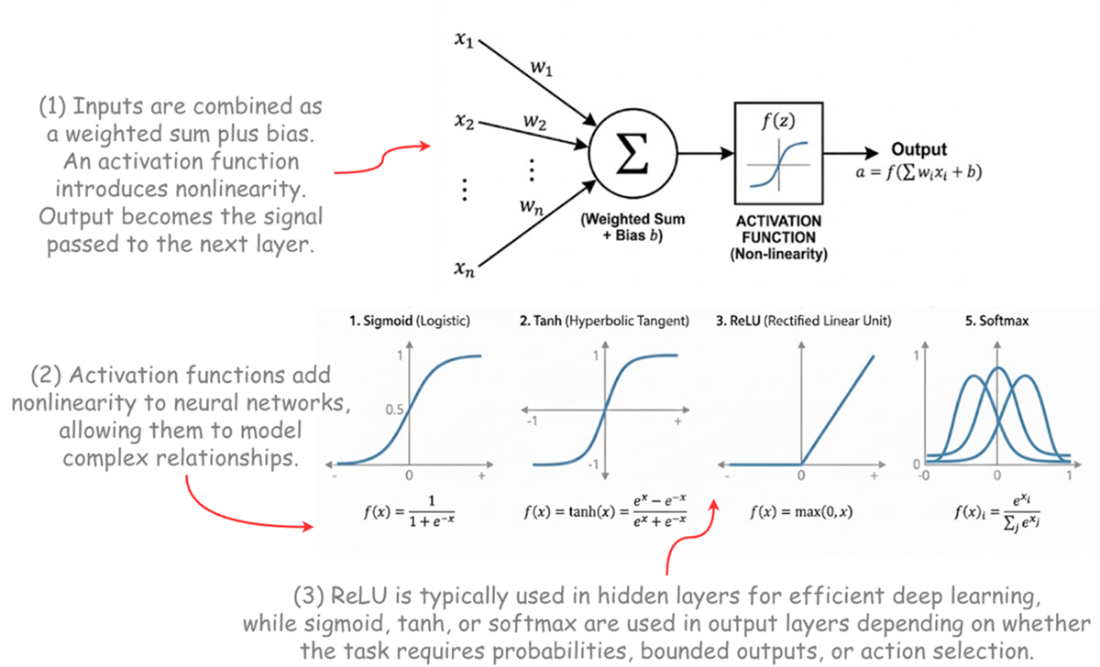
See how a neuron’s weighted input combination and activation form a basic building block of deep networks. section 8.2


How Applied Reinforcement Learning covers it

How deep it goes
Defines the operation as weighted summation plus bias and explains why nonlinear activations are needed between layers.
Examples
Illustrates the operation through a neuron receiving inputs and computing a weighted sum plus bias.
What you can do after
Understand why neural network layers combine weighted inputs and why nonlinear activations add expressive power.
How it connects
Connects linear transformations to neural networks, activation functions, and ReLU.

Also explained in

Compare how 3 books explain linear transformation →

Related concepts

This explainer was generated by Manning's knowledge graph from the text of Applied Reinforcement Learning. The section links point to the parts of the book it draws on.
