A linear transformation maps inputs to outputs by combining input values with learned coefficients. In a neural network, edges between consecutive layers supply those coefficients, called weights. section 10.1
A practical layer also includes a bias: y = mx + b. Weights and biases are network parameters, and stacking transformations with nonlinear activations lets the network represent complex mappings. section 10.1
From edges to a prediction
In a network with hidden layers, the collection of edges from one layer to the next defines a transformation. Each edge weight contributes a coefficient, while the bias shifts the resulting value before the next activation. section 10.1
Figure 10.2 The architecture of an example neural network with two hidden layers of size 6 and 4.
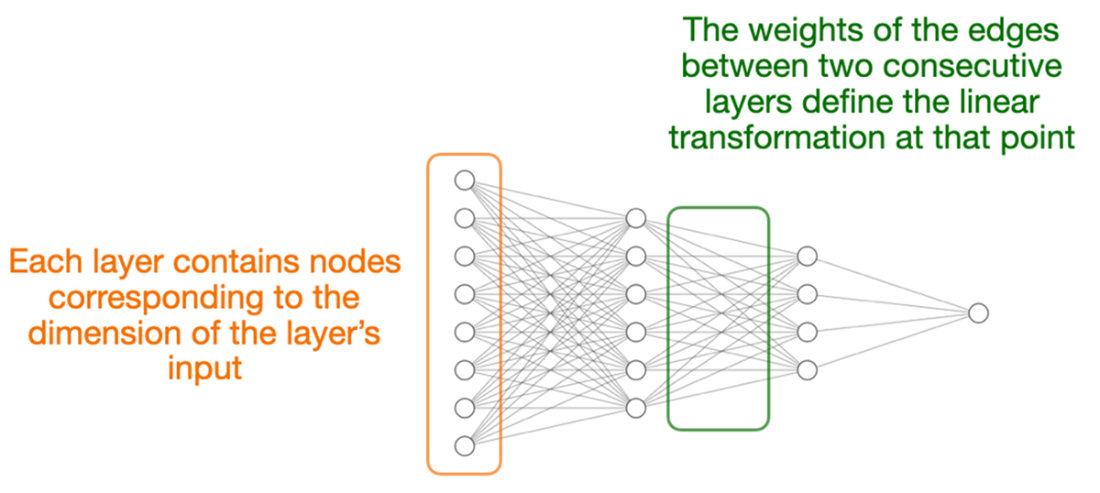
Use the architecture diagram to trace how transformations connect input, hidden, and output layers. section 10.1


