liveBook · Manning

Ai opportunity assessment

As explained in The Art of AI Product Development

An AI opportunity assessment is a structured evaluation of candidate tasks for potential AI value, feasibility, and user desirability.

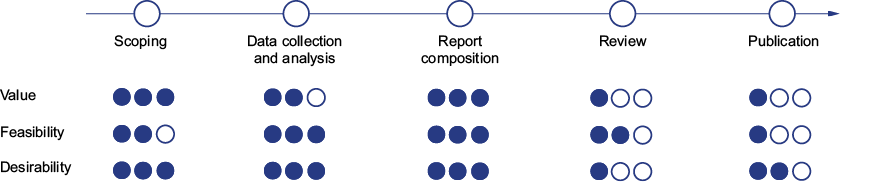
An AI opportunity assessment evaluates tasks in a user journey against value, feasibility, and desirability, then focuses an MVP on the most attractive opportunity. section 10.1.1

Assess candidate tasks by asking:

  • Value: How much time does the task consume, how often does it occur, and what higher-value work could replace it? section 10.1.1
  • Feasibility and desirability: Determine whether AI can address the task effectively and whether users want that support. section 10.1.1
  • Prioritize one or a small number of high-payoff journey stages rather than attempting the full task spectrum in an MVP. section 10.1.1

Sustainability report composition

Drafting a report section can take six hours per topic. AI support could reduce effort by more than 50 percent, improve accuracy and consistency, and leave sustainability managers more time for validating insights, strategic planning, and stakeholder engagement. section 10.1.1

Figure 10.4 The AI opportunity assessment matrix allows you to prioritize the available opportunities.
A blue dot and line with black text

AI-generated content may be incorrect.

Use the opportunity assessment matrix to compare candidate tasks and prioritize the strongest options. section 10.1.1

How The Art of AI Product Development covers it

How deep it goes
Defines three evaluation criteria and value questions, while deferring the full spectrum of journey tasks beyond the MVP.
Examples
Uses sustainability reporting, six-hour report drafting, and opportunity-cost comparisons between writing and strategic work.
What it assumes
Assumes a mapped user journey and access to customers or users for discovering task time, frequency, and value.
What you can do after
Evaluate/understand it by ranking user-journey tasks and selecting a focused, high-payoff AI opportunity for an MVP.
How it connects
Connects user journeys with automation, augmentation, value, feasibility, desirability, and opportunity cost.

Related concepts

This explainer was generated by Manning's knowledge graph from the text of The Art of AI Product Development. The section links point to the parts of the book it draws on.