liveBook · Manning

Product management agent

As explained in The Art of AI Product Development

A product management agent is an AI agent configured to perform product-management tasks such as discovery, prioritization, or roadmap planning.

A product management agent applies agentic AI to product discovery, prioritization, and roadmap planning. It combines selected tools, memory, planning capabilities, prompts, and human-in-the-loop interaction rather than treating model output as an unattended decision. section 9.0

Design decisions include:

  • Choose the tools the agent can access and determine how it manages memory. section 9.0
  • Define planning capabilities and a human–AI interface that supports useful human-in-the-loop interaction without overwhelming users. section 9.0
  • Treat a general agent as limited for complex discovery or roadmapping; specialized agents can handle discovery, prioritization, and roadmap planning under supervision. section 9.4.1

From assistant to supervised team

A basic product management agent can recommend roadmap choices, but may become mediocre on complex work. A supervised system assigns discovery, prioritization, and roadmap planning to specialized agents, while an overarching agent coordinates them toward a shared goal. section 9.4.1

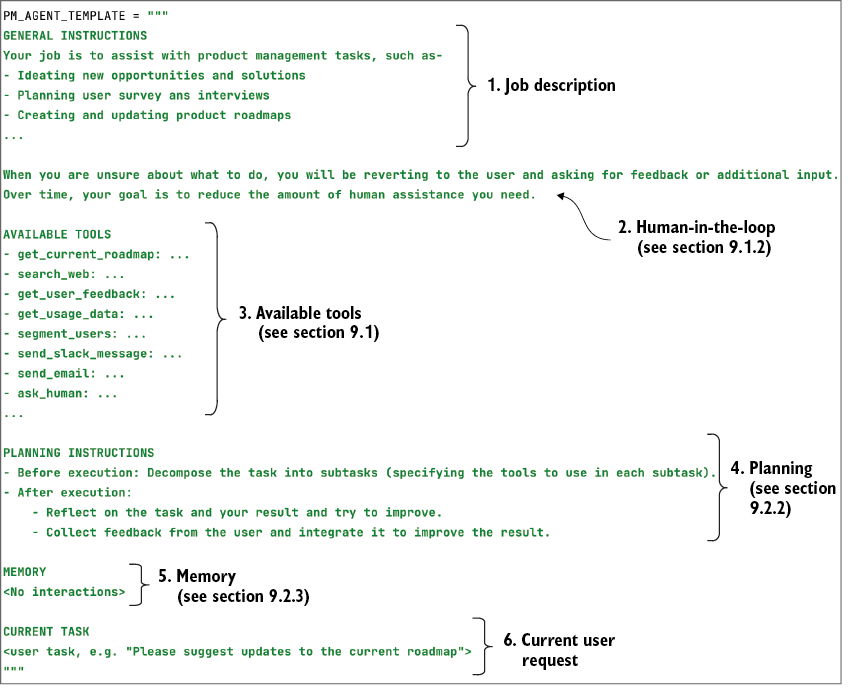
Figure 9.2 Example task prompt for a product management agent
A computer screen with text

AI-generated content may be incorrect.

Use the task-prompt figure to inspect how product-management work is framed for an agent. section 9.0

How The Art of AI Product Development covers it

How deep it goes
Explains tools, memory, planning, prompts, and human interaction, then limits single-agent complexity through specialized-agent supervision.
Examples
Uses a product task prompt, roadmap recommendations, specialized discovery agents, and a supervisor coordinating product agents.
What it assumes
Assumes familiarity with generative AI concepts while teaching agent components, interaction design, and practical limitations.
What you can do after
Build it from scratch by selecting tools, configuring memory and planning, designing HITL interaction, and iterating prompts and configurations.
How it connects
Connects product discovery, prioritization, roadmap planning, human-in-the-loop interaction, planning, memory, and multi-agent systems.

Related concepts

This explainer was generated by Manning's knowledge graph from the text of The Art of AI Product Development. The section links point to the parts of the book it draws on.