A probabilistic vector represents an input as a distribution over possible latent values rather than one fixed point. In a variational autoencoder (VAE), the encoder describes each element with a mean and standard deviation, and the decoder reconstructs an output from a sampled vector. Different samples can therefore produce slightly different results. section 7.3.1
A face-image VAE can compress a 3 × 256 × 256 image into a 100-value probabilistic vector whose elements follow independent normal distributions. Sampling from that representation and decoding it supports reconstruction and generation of novel faces. Its organized latent space also makes nearby representations suitable for interpolation and arithmetic. section 7.0 section 7.3.1
Encoding arithmetic
Let z1 represent a man with glasses, z2 a woman with glasses, and z3 a woman without glasses. Computing z4 = z1 − z2 + z3 and decoding it can produce a man without glasses: subtracting shared characteristics and adding the desired remainder changes the generated image. section 7.0
Figure 7.1 Generating images of women with glasses by performing encoding arithmetic
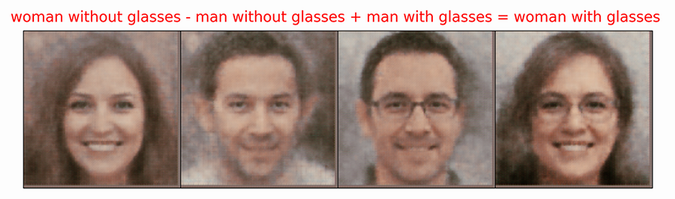
Visualizes how encoding arithmetic generates images with targeted attributes. section 7.0
