A probabilistic vector represents an input as a distribution over possible latent values rather than as one fixed code. In a variational autoencoder (VAE), each element commonly follows an independent normal distribution described by a mean and standard deviation. Sampling from the vector before decoding produces slightly varied outputs. section 7.3.1
Compared with a deterministic autoencoder vector, a probabilistic vector supports:
- Continuous latent spaces in which similar inputs map to nearby representations. section 7.0
- Image reconstruction by sampling a latent vector and decoding the sample. section 7.3.1
- Encoding arithmetic and interpolation, allowing decoded characteristics to be manipulated. section 7.0
A 100-value image representation
A VAE compresses a 3 × 256 × 256 color image into a 100-value probabilistic vector. For each value, the encoder supplies a mean and standard deviation; sampling produces a latent vector for the decoder. With z1 for a man with glasses, z2 for a woman with glasses, and z3 for a woman without glasses, decoding z4 = z1 − z2 + z3 can produce a man without glasses. section 7.0 section 7.3.1
Figure 7.1 Generating images of women with glasses by performing encoding arithmetic
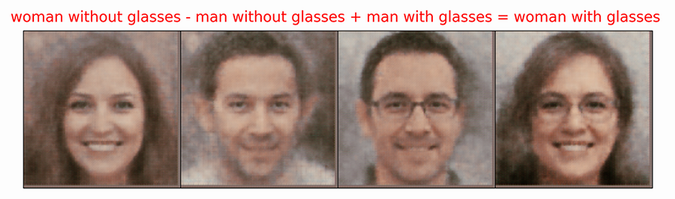
Illustrates how encoding arithmetic generates images with selected visual characteristics. section 7.0
