x is the input sequence of music-token indexes used to predict the next musical event in a training pair. section 14.1.3 section 14.2.3
It is formed by converting music into token indexes, then slicing fixed-length sequences and pairing each input with a one-step-shifted target. section 14.1.3 section 14.2.3
In this training setup, x supports the model workflow by:
- holding the current music context for each example. section 14.1.3
- feeding the forward pass before loss is computed against the shifted y sequence. section 14.1.3
- using 2,048 indexes per sequence to capture long-range musical dependencies. section 14.1.3 section 14.2.3
Music training pair
If a music piece exceeds 2,048 indexes, x uses the first 2,048 indexes and y uses the next indexes shifted one position to the right. section 14.2.3
Listing 14.5 Creating training data
import torch,os,pickle

max_seq=2048
def create_xys(folder):
    files=[os.path.join(folder,f) for f in os.listdir(folder)]
    xys=[]
    for f in files:
        with open(f,"rb") as fb:
            music=pickle.load(fb)
        music=torch.LongTensor(music)
        x=torch.full((max_seq,),389, dtype=torch.long)
        y=torch.full((max_seq,),389, dtype=torch.long)      #1
        length=len(music)
        if length<=max_seq:
            print(length)
            x[:length]=music                                #2
            y[:length-1]=music[1:]                          #3
            y[length-1]=388                                 #4
        else:
            x=music[:max_seq]
            y=music[1:max_seq+1]
        xys.append((x,y))
    return xys
Shows the create_xys() routine that builds x and y pairs, including padding, shifting, and end-of-sequence handling. section 14.2.3
Figure 14.2 The training process for a music Transformer to generate music
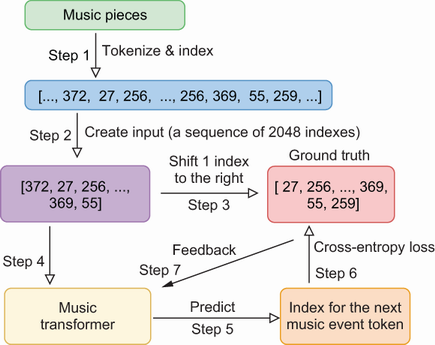
Diagram of the music Transformer training flow where x is the input sequence and y is the shifted target. section 14.1.3
