liveBook · Manning

Local pattern

As explained in Deep Learning with Python, Third Edition

A pattern that occurs within a limited neighborhood of the input rather than across the whole input space.

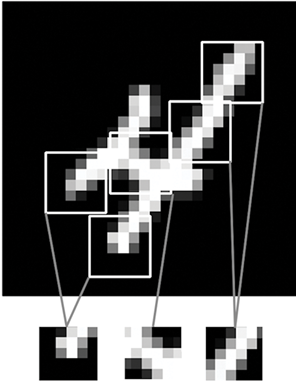
A local pattern is a feature found within a limited neighborhood of an input rather than across the whole input. In images, convolutional layers detect patterns in small windows, such as 3 × 3 regions, and apply the same transformation at every location. section 8.1.1

Local patterns make image recognition practical in three important ways:

  • They support translation-invariant recognition: a learned edge or texture can be recognized in a different position. section 8.1.1
  • They build spatial hierarchies: early layers detect edges and textures, while later layers combine them into larger visual concepts. section 8.1.1
  • They produce feature maps by extracting patches from an input and transforming each patch into output channels. section 8.1.1
Figure 8.1 Images can be broken into local patterns such as edges, textures, and so on.
visual hierarchy hires

Use the figure to visualize images as collections of local features, including edges and textures. section 8.1.1


How Deep Learning with Python, Third Edition covers it

How deep it goes
Defines local patches, explains shared transformations and feature maps, and connects them to hierarchical visual learning.
Examples
Uses 3 × 3 image windows, edges, textures, RGB channels, and increasingly complex visual concepts.
What you can do after
Understand how convolutional layers detect and combine local image features across an input.
How it connects
Connects convolutional layers with dense layers, translation invariance, feature maps, and spatial hierarchies.

Also explained in

Compare how 2 books explain local pattern →

Related concepts

This explainer was generated by Manning's knowledge graph from the text of Deep Learning with Python, Third Edition. The section links point to the parts of the book it draws on.