The logit lens makes a Transformer’s evolving predictions inspectable: it projects each layer’s hidden state through the model’s final normalization and prediction head, producing a vocabulary distribution for that point in the forward pass. section 10.0 section 10.3
A typical workflow is:
- Run the model with output_hidden_states=True. In the Llama-3.2-1B example, discard the embedding output and process the 16 Transformer-block outputs. section 10.3
- For each layer, select the final token’s hidden state, apply the model’s final normalization and lm_head, then use softmax and top-k to inspect likely tokens and probabilities. section 10.3
Listing 10.10 The logit lens function
def logit_lens(model, tokenizer, hidden_states, topk=3):
    final_norm = model.model.norm #A
    lm_head = model.get_output_embeddings() #B
    results = []
    for hs in hidden_states[1:]: #C
        last_token_hs = hs[0, -1, :] #1
        normed = final_norm(last_token_hs)
        logits = lm_head(normed)
        probs = torch.softmax(logits.float(), dim=-1)
        top = torch.topk(probs, topk)
        tokens = [tokenizer.decode([idx]) for idx in top.indices.tolist()]
        results.append(list(zip(tokens, top.values.tolist())))
    return results
The function shows the per-layer projection and top-k steps. section 10.3
Layer-wise prediction
For “The most significant building in Barcelona is the”, a top-three-per-layer table shows how candidate tokens and their probabilities change across the network. section 10.3
Figure 10.4 Logit lens top-three tokens per layer for the prompt "The most significant building in Barcelona is the". Each cell shows the top-three predicted tokens and their probabilities for one layer, projected through the model's final normalization and lm_head. Background intensity encodes the top-1 probability, with darker cells indicating higher confidence.
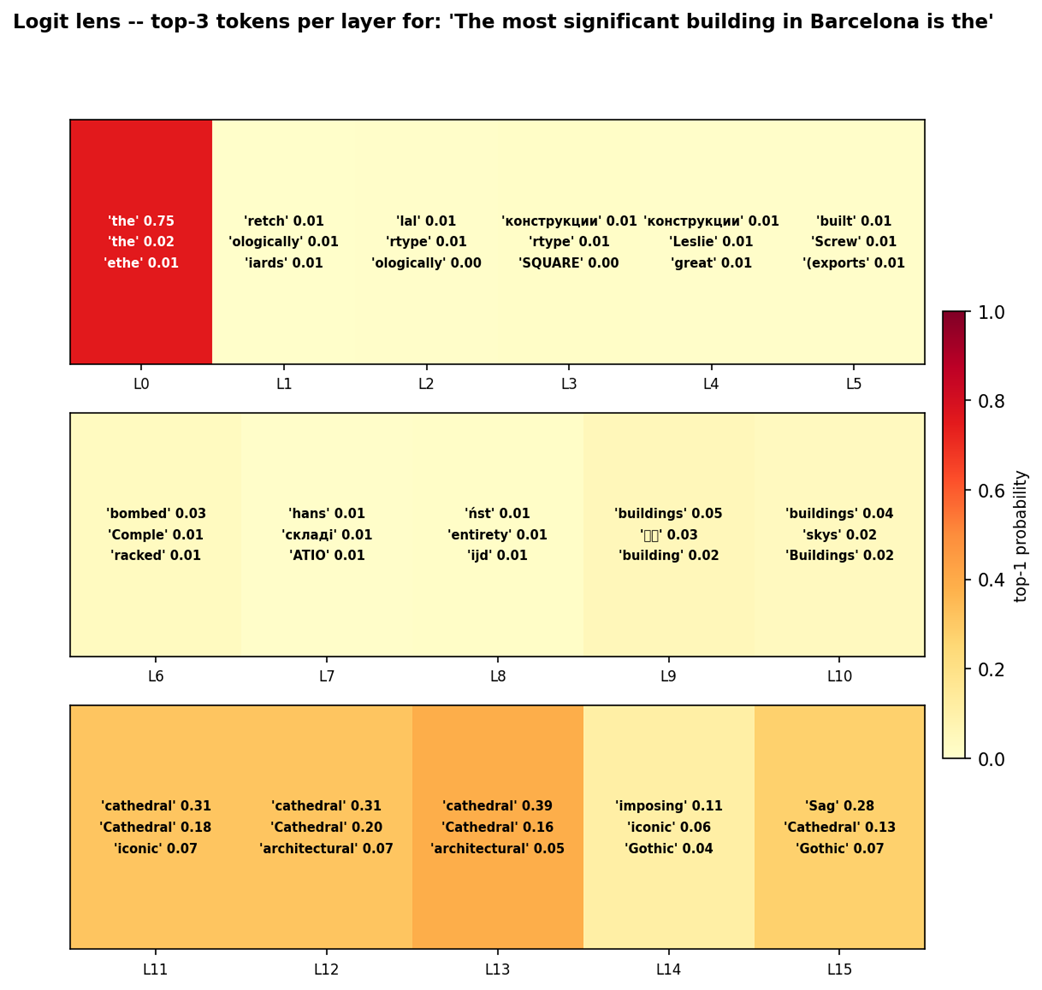
The figure visualizes top-three predictions per layer, with background intensity indicating top-token probability. section 10.3
The direct lens is not reliable for every architecture; the described requirement is Pre-LayerNorm. The tuned lens instead trains an affine transformation per layer, at the cost of requiring training. section 10.4
