liveBook · Manning

Loop guard

As explained in Acing the CCNA Exam: Volume 1 Fundamentals and Protocols

Loop Guard is a spanning-tree protection feature that places a port into a loop-inconsistent state when expected BPDUs stop arriving, preventing erroneous transition to forwarding.

Loop Guard adds STP/RSTP protection against Layer 2 loops. If a discarding port stops receiving BPDUs, it enters the loop-inconsistent state instead of moving to forwarding. section 15.4 section 15.4.2

Figure 15.9 A loop is caused when SW3 stops receiving BPDUs from SW2. (1) A software malfunction on SW2 prevents it from sending BPDUs. (2) After the max age timer counts down, SW3’s port becomes a designated port and transitions to the forwarding state. (3) All three links between the switches are active, resulting in a Layer 2 loop.
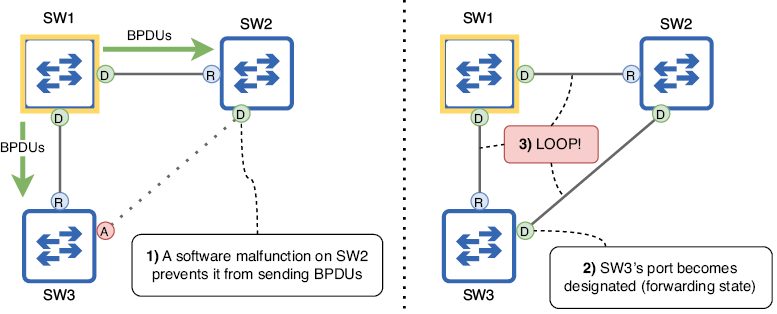
A software failure can stop BPDU transmission; after the max-age timer expires, the port may otherwise become designated and forward, activating all links and creating a Layer 2 loop. section 15.4.2

Configure and interpret Loop Guard as follows:

  • Enable it under the interface with spanning-tree guard loop. section 15.4.2
  • Recognize a blocked port as BKN and LOOP_Inc in spanning-tree output. section 15.4.2
  • Expect automatic recovery when BPDUs resume; do not combine Loop Guard with Root Guard on one port. section 15.4.2

How Acing the CCNA Exam: Volume 1 Fundamentals and Protocols covers it

How deep it goes
Explains BPDU-loss behavior, port states, recovery, exclusivity, configuration, and verification output.
Examples
Uses SW2/SW3 BPDU failure, a three-link loop scenario, Cisco interface configuration, and spanning-tree output.
What it assumes
Builds on STP/RSTP, BPDUs, discarding or blocking states, forwarding, and Layer 2 loops.
What you can do after
Apply it via Cisco interface configuration and diagnose loop-inconsistent blocking in spanning-tree output.
How it connects
Links STP, RSTP, BPDUs, Layer 2 loops, Root Guard, and spanning-tree port states.

Related concepts

This explainer was generated by Manning's knowledge graph from the text of Acing the CCNA Exam: Volume 1 Fundamentals and Protocols. The section links point to the parts of the book it draws on.