Coupling is the dependency between software components: changing one component can require corresponding changes in others. It resists change by forcing coupled components to evolve in sync, increasing effort and complexity, while remaining unavoidable in a DSL-based approach. section 10.2
Analyze coupling by separating component code and charting how changes propagate:
- Classify code as DSL-specific, DSL-generic, or DSL-aspecific. DSL-specific code implements a particular DSL’s key aspects; DSL-generic code supports multiple DSLs; DSL-aspecific code is remaining boilerplate. section 10.4
- Draw arrows from the component causing a change to the affected component. Arrow direction shows cause and effect; thickness represents coupling strength. section 10.2
- Relate components to the DSL’s key aspects, especially its structure. Most DSL-specific code depends on the DSL structure. section 10.2 section 10.4
- Test structural changes such as adding, removing, renaming, or changing properties and concepts, including coordinated changes made in lockstep. section 10.4
- Manage incompatible DSL content with version identifiers and migration actions when the Domain IDE loads content. section 10.4
Figure 10.9 A chart of coupling between the DSL’s key aspects and the DSL-specific parts of components
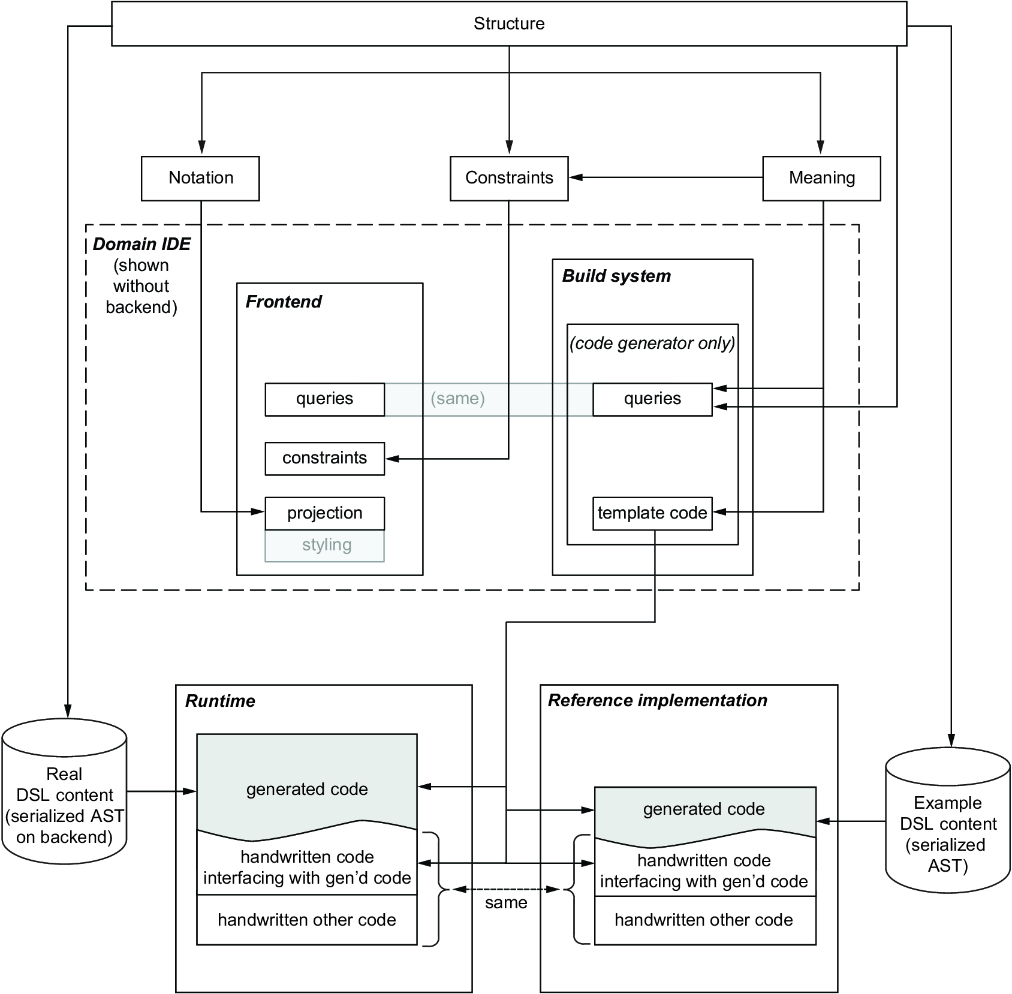
Use the coupling chart to trace dependencies between the DSL’s key aspects and DSL-specific component code. section 10.2
















