Loose coupling is an architectural property in which engineering-platform domains interact through low-friction boundaries rather than depending heavily on one another. Each domain can remain self-service and evolve with appropriate autonomy, preserving the ability to change responsibilities without widespread coordination. section 3.5.4 section 1.3.2
Design for loose coupling by:
- Defining domain boundaries deliberately and measuring whether they continue to support the intended user experience. section 1.3.2
- Keeping dependencies explicit and ordered where necessary, while allowing independent domains to evolve after foundational infrastructure is available. section 6.1 section 1.3.2
- Treating repeated requests for cross-team coordination as a boundary smell rather than an acceptable operating model. section 1.3.2
Scaling a platform team
A single engineering-platform team can own several domains during MVP development. As demand and feature velocity grow, it can hand subdomains to similarly organized teams because the architecture provides low-friction boundaries between platform areas. section 6.1
Figure 1.4 Eight principal product domains within an engineering platform. The numbers by the domain indicate an underlying dependency ordering when launching a new platform.
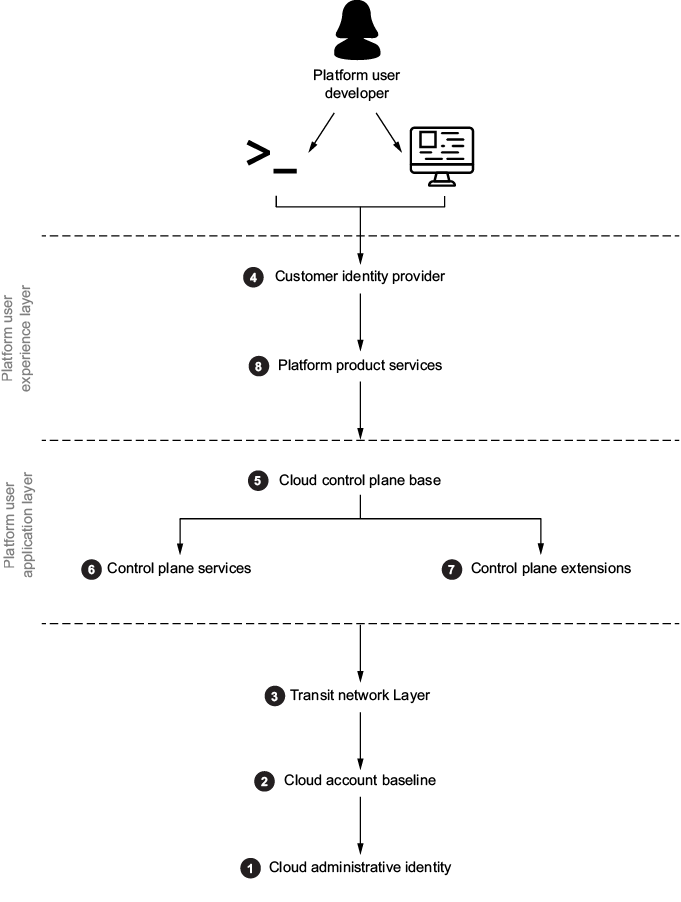
Use the domain map to inspect how platform areas are separated, ordered, and connected while the platform is launched. section 1.3.2
















