LSA flooding distributes link-state advertisements (LSAs) through an OSPF area. Each router advertises its connected networks to neighbors, which forward the information across the area. section 18.1.1
The resulting LSAs form the link-state database (LSDB), giving every router the same topology map. Routers then use the SPF algorithm to calculate routes to destination networks. section 18.1.1 section 18.5
A practical sequence is:
- Create an LSA describing connected networks and link costs. section 18.1.1
- Send the LSA to neighboring OSPF routers for propagation. section 18.1.1
- Build an identical LSDB across the OSPF area and calculate shortest paths. section 18.1.1
Figure 18.1 Routers flood LSAs within the OSPF area to ensure all routers have an identical LSDB. The LSAs that make up the LSDB contain information about each router’s connected networks, such as their cost. R1’s LSA indicates that it is connected to 10.0.0.0/30, 10.0.0.4/30, and 10.1.1.0/24, each with a cost of 1.
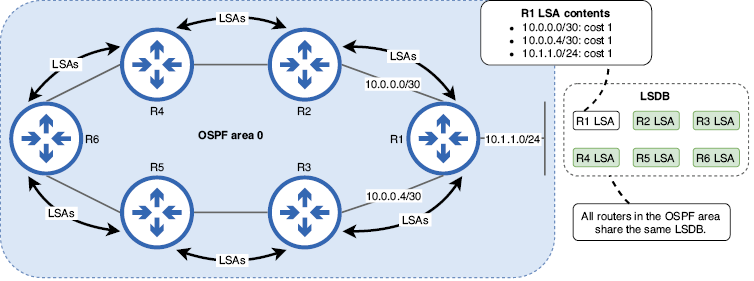
Use the topology figure to trace how routers flood LSAs and how an LSA records connected networks and their costs. section 18.1.1
