Machine learning engineering applies engineering practices and design patterns to build, evaluate, deploy, and operate machine learning systems. It treats delivery as an iterative process spanning stakeholders, user experience, constraints, data, modeling, and serving. section 1.3
A practical machine learning engineering effort coordinates:
- Business goals, user experience, performance constraints, evaluation, personalization, people, compute, and infrastructure. section 1.3
- Data pipelines that address privacy, bias, storage, preprocessing, and availability. section 1.3
- Model selection, training, debugging, hyperparameter tuning, scaling, evaluation, and field-serving assumptions. section 1.3
- Version control and automated pipelines for code, models, features, data transformation, testing, and deployment. section 1.3
Figure 1.4 ML project flow as described in Huyen and Hopper (2020). Figure redrawn and adapted by the author. Arrows represent dependency relations rather than workflow.
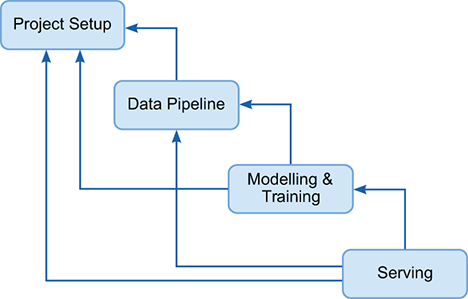
Use the project-flow figure to trace dependencies across iterative machine learning development and delivery. section 1.3

