A magic state is a specially prepared ancillary state that extends the limited gate set available to logical qubits. Rough approximations are refined through magic state distillation, then consumed to implement otherwise unsupported gates. section 9.3
The standard example is the T state, |T⟩ = T|+⟩ = (|0⟩ + e^{iπ/4}|1⟩)/√2, paired with T = diag(1, e^{iπ/4}). Together with supported simple gates, T gates can approximate any single-qubit gate. section 9.3
Magic state distillation
A separate quantum-computing area prepares and distills magic states in parallel with the main computation. Depending on the program's gate usage, this supply process can dominate fault-tolerant resource requirements. section 9.3
Figure 9.5 Physical qubits are noisy, they support a limited set of gates, and these gates are slow. We have to use error correction to enable reliable computation on noisy qubits. We also have to use a special process to implement arbitrary logical gates on logical qubits. These factors affect both the run time of algorithms on the quantum computers and the numbers of qubits required to run them.
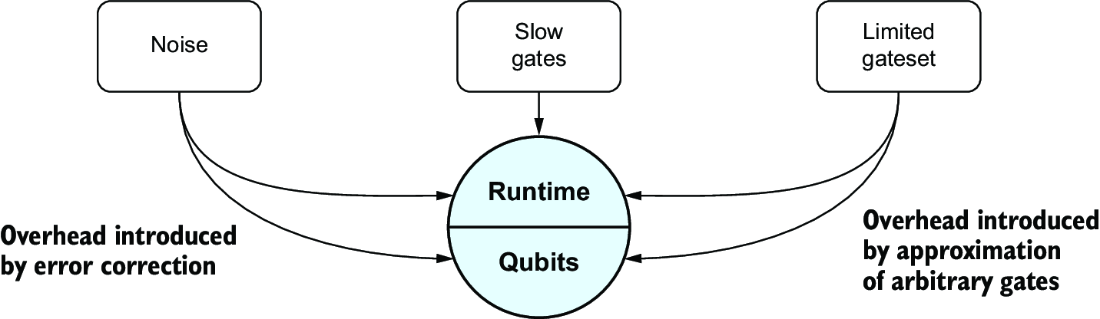
Relates limited logical gate sets and special arbitrary-gate implementation processes to runtime and qubit requirements. section 9.3
