Magic state distillation refines rough approximations of special resource states so unsupported magic gates can be used in fault-tolerant quantum programs. The process runs separately from the main computation and supplies gates needed to approximate operations such as arbitrary rotations. section 9.3
Its role in resource estimation follows from three architectural constraints:
- Logical qubits directly support only a limited set of operations. section 9.3
- Unsupported gates are generated indirectly through magic gates and their companion magic states. section 9.3
- Distillation can become a major contributor to the qubits and runtime required by a program. section 9.3 section 9.8
The T gate and T state
A representative magic gate is T = diag(1, e^{iπ/4}), with matching state |T⟩ = T|+⟩ = (|0⟩ + e^{iπ/4}|1⟩)/√2. Combined with supported gates, T enables arbitrary single-qubit gates to be approximated as precisely as required. section 9.3
Figure 9.5 Physical qubits are noisy, they support a limited set of gates, and these gates are slow. We have to use error correction to enable reliable computation on noisy qubits. We also have to use a special process to implement arbitrary logical gates on logical qubits. These factors affect both the run time of algorithms on the quantum computers and the numbers of qubits required to run them.
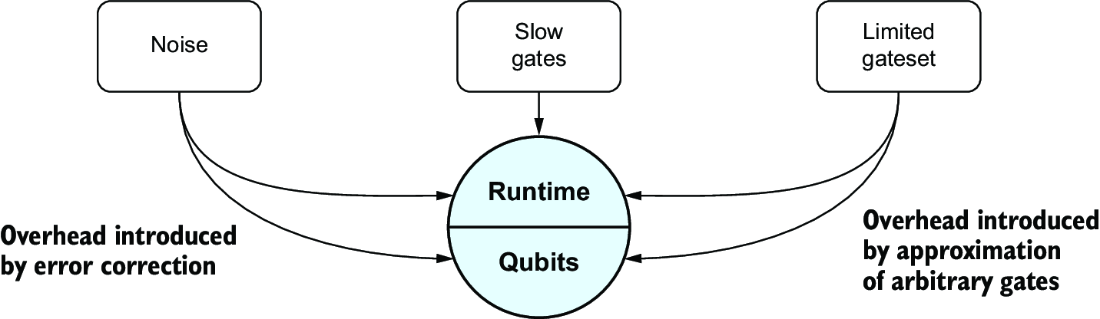
Relates noisy physical qubits, error correction, limited gate sets, and special gate-generation processes to runtime and qubit-count overhead. section 9.3
