Maintainability is how little pain a test suite causes when software changes. A test is maintainable when developers can understand, correct, and evolve it without repeatedly rewriting it for harmless production changes. A suite that is expensive to change stops helping: under schedule pressure, people defer repairs, stop trusting results, and may return to manual testing. section 8.0 section 7.0
Maintainability is related to readability and trust, but they are not the same. Readability lets someone see what a test means and diagnose whether the test itself is wrong. Trust means its pass or fail result is worth acting on. Maintainability concerns the ongoing cost of keeping tests useful; poor readability undermines both maintenance and trust. section 7.0 section 1.8
Reduce avoidable test changes by keeping tests focused on observable behavior:
- Treat a failure as a signal to investigate. A real production defect is a true failure; a test failure unrelated to an underlying defect is a false failure. Tracking false failures and their causes gives a practical measure of maintenance trouble. section 8.1
- Assert meaningful output rather than incidental formatting. Exact string equality can make a test fail after harmless whitespace or presentation changes; partial matching preserves the important message. section 2.5.4
- Name mocks and stubs distinctly, and avoid asserting stubs. Verifying internal queries instead of changed application behavior couples tests to implementation details. section 4.4
- Keep one requirement per interaction-focused test. Multiple mocks can hide later verification failures, while many expectations make a test difficult to read and maintain. section 4.4 section 5.6.2
- Prefer simple interfaces at boundaries. A dependency with many functions and parameters requires more fake behavior, increasing complexity in both production and test code. section 4.8.1
Test the message, not its decoration
Suppose validation returns an error containing “fake reason.” An exact comparison can break when a newline or extra explanation is added, even though the behavior still communicates the reason. A partial assertion keeps the test aimed at the core requirement: expect(errors[0]).toContain('fake reason'); This does not mean ignoring output details that matter. It means choosing an assertion boundary that fails when the relevant production behavior is wrong, rather than when incidental text changes. section 2.5.4
Maintainability also affects test-strategy choices. Unit and component tests are generally easier to maintain, faster, and less complex or flaky, but provide less confidence than broader tests. End-to-end tests offer stronger confidence at higher maintenance, speed, complexity, and flakiness costs. A useful suite balances levels instead of relying only on either end. section 10.5
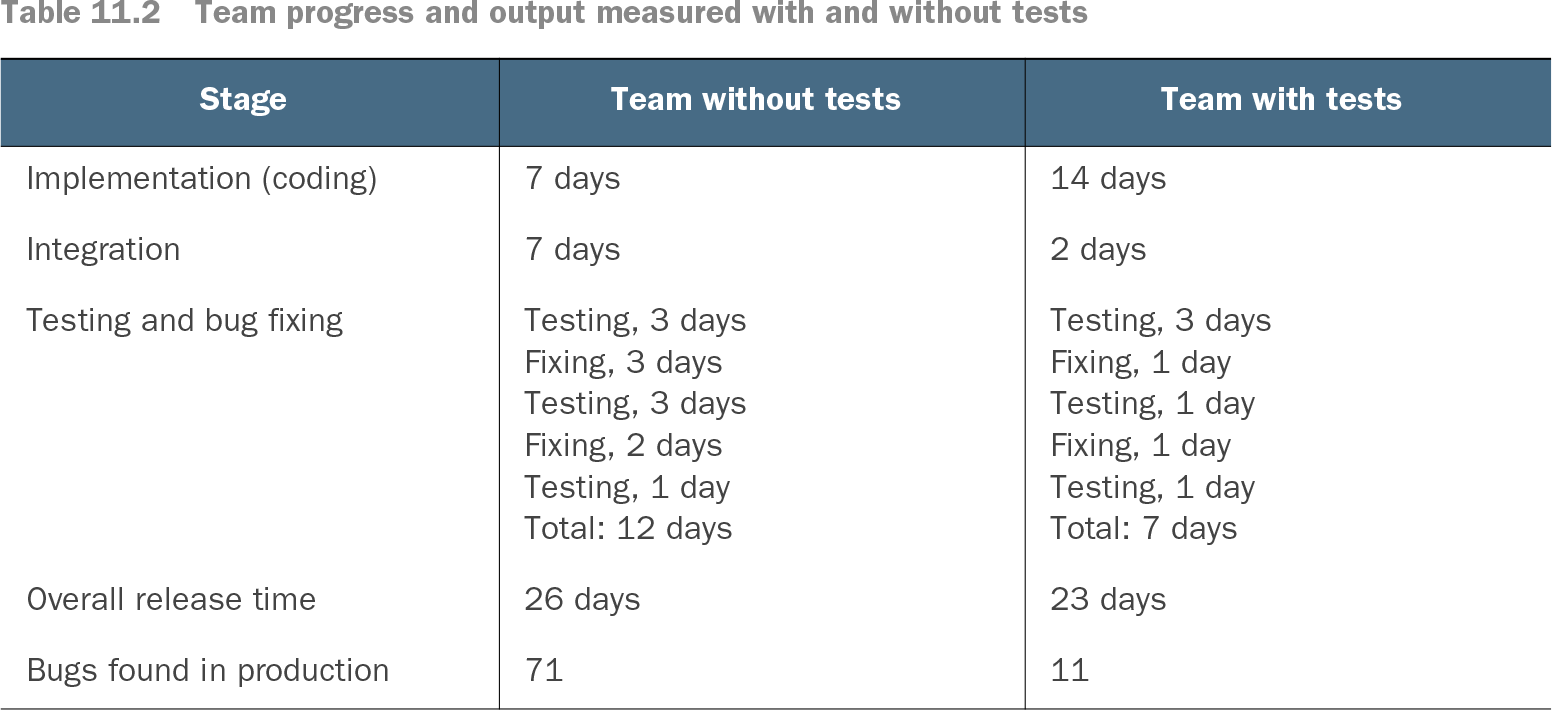
Table 11.2 Team progress and output measured with and without tests (view table figure)
| Testing, 3 days Fixing, 3 days Testing, 3 days Fixing, 2 days Testing, 1 dayTotal: 12 days |
Testing, 3 days Fixing, 1 dayTesting, 1 dayFixing, 1 dayTesting, 1 dayTotal: 7 days |
|
Compare measured development stages, release time, and production bugs for teams working with and without tests; the table illustrates how added implementation effort can be offset later by easier integration and bug fixing. section 11.5.1