A man-in-the-middle attack, also called an on-path attack, places an attacker silently between a user and a legitimate destination. The attacker can observe or alter the communication while both parties believe they are connected directly. section 12.3.6
The attack can operate in two main ways:
- Passive attacks listen for sensitive information such as login credentials, financial data, or personal information without changing the traffic. section 12.3.6
- Active attacks modify or reuse communications, such as changing transaction details, injecting malicious content, sending fraudulent messages, or replaying authentication requests. section 12.3.6
- A successful spoofing attack can help an attacker impersonate a trusted server or device and intercept the connection. section 12.3.6
Example: a bank connection
A user thinks they are connecting directly to their bank’s website, but the attacker has broken the original connection. The attacker can read sensitive information or alter a transaction before forwarding traffic. section 12.3.6
Figure 12.7 Illustration of an on-path attack scenario.
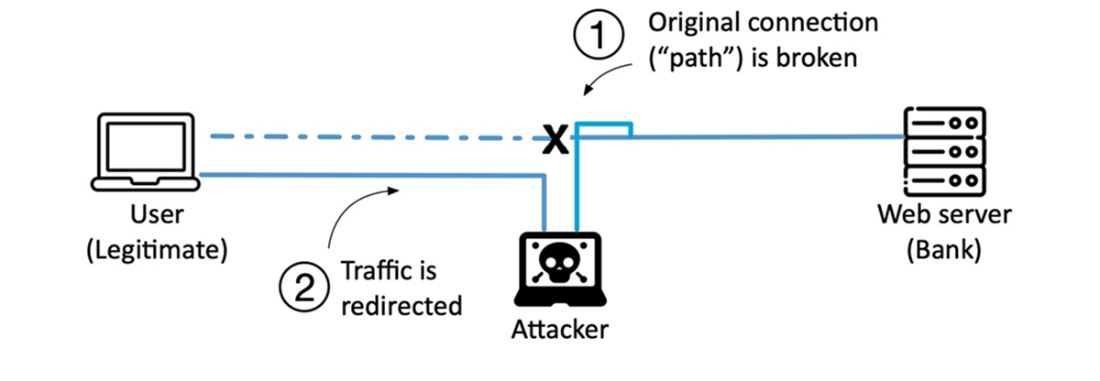
Use the communication-path illustration to trace how the attacker intercepts traffic between the user and the bank website. section 12.3.6
Protection combines strong encryption and secure authentication protocols, including HTTPS, TLS, and VPNs. Timestamps, nonces, session tokens, and challenge-response mechanisms help prevent intercepted messages from being reused in replay attacks. section 12.3.6




