A Management Information Base (MIB) is a structured database of variables describing a managed device. Variables can represent interface status, CPU utilization, temperature, power-supply health, or routing-neighbor state. SNMP uses the MIB as the information model that an NMS reads, modifies, or monitors. section 6.1 section 6.4
SNMP interacts with MIB variables through three operational patterns:
- Get, GetNext, and GetBulk messages let an NMS read one or more MIB variables; Response messages return the requested information. section 6.1.1
- Set messages let an NMS modify MIB variables and centrally apply configuration changes, initiate reboots, or back up device configuration files. section 6.1.1 section 6.4
- Trap messages let a managed device notify the NMS when a monitored event occurs, such as an interface going down. section 6.1.1
- Object identifiers (OIDs) uniquely identify variables and organize them in a hierarchical, tree-like structure. section 6.1.2 section 6.4
Reading interface status
An NMS sends a Get message for the GigabitEthernet0/1 status variable. The managed device returns a Response reporting whether the interface is up or down. The variable ifOperStatus is identified by OID 1.3.6.1.2.1.2.2.1.8. section 6.1 section 6.1.1 section 6.1.2
Figure 6.6 A small segment of the SNMP OID hierarchy. 1.3.6.1.2.1.2.2.1.8 is the OID of the ifOperStatus variable.
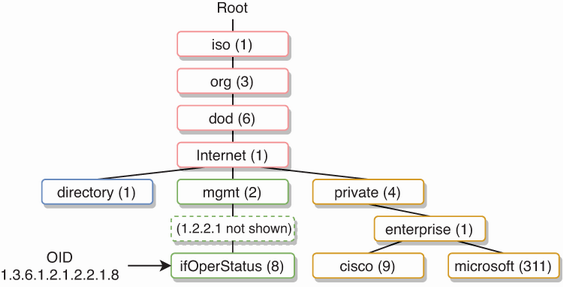
Use the OID hierarchy diagram to trace how a numeric identifier locates the ifOperStatus variable inside the MIB. section 6.1.2
