MapReduce divides distributed computation into independent mapping work and reduction into an aggregate result. In GraphRAG, it organizes global question answering over precomputed community summaries rather than raw documents. section 12.2 section 12.2.2
A GraphRAG MapReduce query follows this sequence:
- Select a hierarchy level whose community summaries balance detail, breadth, and token cost. section 12.2.2
- Shuffle summaries to reduce positional anchoring, then pack them into context-window-sized batches. section 12.2.2
- Map each batch into a helpfulness score and a query-specific partial answer; discard zero-helpfulness results. section 12.2.2
- Reduce the surviving answers by ranking them, filling the final context window, and synthesizing one response. section 12.2.2
Recurring outage causes
For ten years of SaaS incident reports, naive retrieval may return the loudest individual outages. GraphRAG instead summarizes communities such as authentication, data, and deployment, then maps the global question across those summaries and reduces the useful partial answers into a cross-cutting explanation. section 12.2 section 12.2.2
Figure 12.3 The summarization pyramid. The four phases of GraphRAG (extraction, community detection, hierarchical summarization, and Map-Reduce search) build and query this structure.
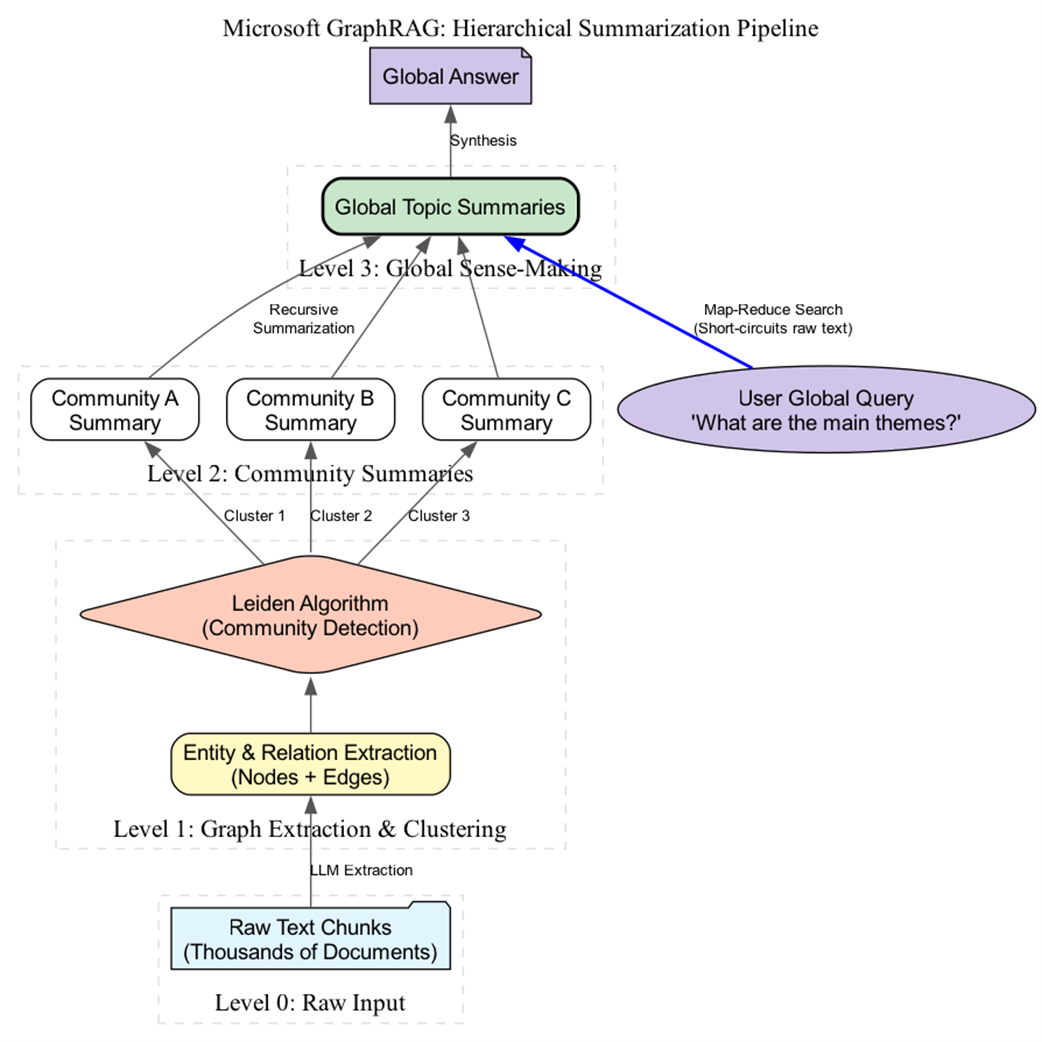
Use the summarization pyramid to trace how raw chunks become entity communities, hierarchical summaries, and a MapReduce query path. section 12.2
MapReduce shifts substantial work into indexing: understanding is computed once and queried repeatedly. This supports large corpora, but requires heavier indexing and careful choices about summary level, context limits, and helpfulness filtering. section 12.2 section 12.2.2