MapReduce is a programming model for processing large datasets across clusters of computers. It divides work into map operations, which produce intermediate key-value pairs, and reduce operations, which combine values associated with each key. Parallel processing makes problems on the scale of web search more tractable. section 6.2.2
At large scale, even reliable individual machines fail regularly. MapReduce shifts part of the reliability burden from commodity hardware to software: a master assigns tasks to workers, receives their results and status updates, and reassigns work when a worker stops reporting. section 6.2.2 section 9.4.10
Figure 6.6. The roles of master and worker are depicted using the little elephant logo of the open source Hadoop implementation of MapReduce. The master divides the problem into tasks and assigns them to workers. Each worker performs its task and writes back a result that the master gathers into an overall result.
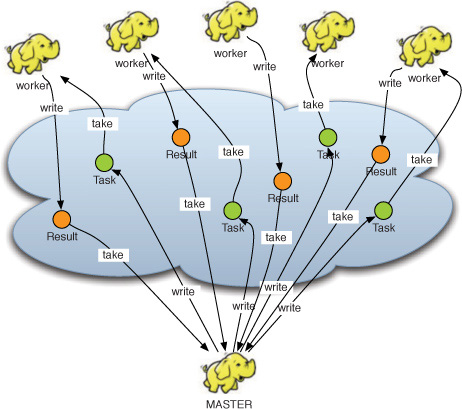
The master divides a problem into tasks; workers perform them and return results for an overall result. section 6.2.2
Counting words
A map operation emits a word and a count of one for each occurrence in a document. A reduce operation adds the counts associated with each word and emits the result. section 6.2.2
Hadoop provides an open-source implementation of MapReduce. Documented uses include product search, log analysis, web crawling, and large-scale image conversion. The practical appeal is the combination of parallel processing and software-managed recovery, rather than an assumption that hardware will not fail. section 6.2.3 section 6.2.2