Market risk is the possibility that broad market trends reduce an investment’s value, even when its individual company performs well. Economic downturns, geopolitical events, and changing sentiment can produce widespread declines. section 7.1.2
Separate market-wide exposure from risks concentrated in particular investments:
- Sector risk affects companies exposed to the same industry forces, such as regulation, demand shifts, or technological disruption. section 7.1.2
- Asset-specific risk arises from company problems such as mismanagement, declining sales, product failures, or scandals. section 7.1.2
- Risk matrices organize potential threats by likelihood and severity, helping prioritize mitigation for consequences that could be especially harmful. section 7.1.3
Stress-test a portfolio
For holdings such as Coca-Cola, Apple, and Pfizer, ask what another pandemic, a trade war, rising energy prices, or an anti-AI movement could do to prices and business prospects. Investigate unfamiliar catalysts before deciding whether the exposure is acceptable. section 7.1.3
Figure 7.3 How to map risk in a matrix based on severity and likelihood. We commonly create strategies to meet risks with higher harm severity first to mitigate the effect once the consequences become unavoidable.
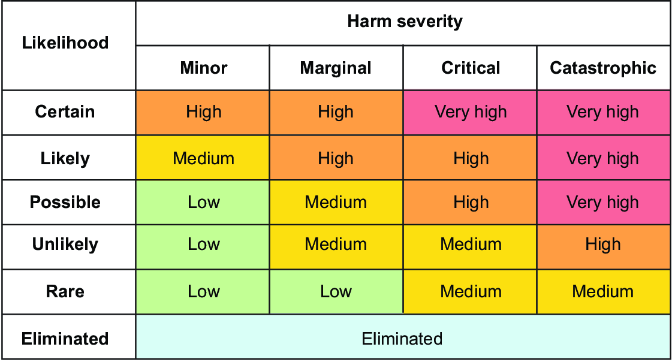
Map threats by likelihood and severity, then address higher-harm risks first. section 7.1.3
