A Markov chain is a stochastic model for moving through possible states when the next transition depends only on the fully observable current state, not earlier events. section 5.2.2
State transitions
From state A, the process may move to neighboring state B according to transition probability pAB; related probabilities describe moves among A, B, and C. section 5.2.2
Markov chains support several practical uses:
- Model random search in simulated annealing, where improving solutions are accepted and some non-improving moves are accepted probabilistically. section 5.2.2
- Represent processes in stochastic optimization, economics, speech recognition, weather prediction, control systems, and web navigation through PageRank. section 5.2.2
Markov chain—pAB, pBA, pBC, and pCB are transition probabilities between the states A, B, and C.
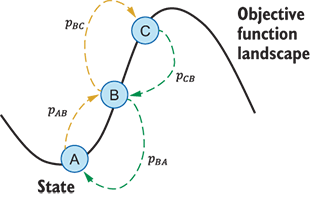
Use the state diagram to inspect how transition probabilities connect neighboring states. section 5.2.2



