The Markov property describes a memoryless random process: the next state depends only on the current fully observable state, not on earlier events. A Markov chain models these possible moves with transition probabilities between states. section 5.2.2
State transitions
For states A, B, and C, moving from A to B is governed by a transition probability such as pAB. Earlier states do not affect that probability once the current state is known. Simulated annealing uses this idea to move between candidate solutions, always accepting improvements while sometimes accepting non-improvements to avoid local minima. section 5.2.2
Markov chain—pAB, pBA, pBC, and pCB are transition probabilities between the states A, B, and C.
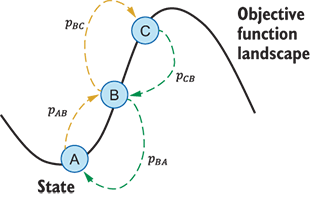
A state-transition diagram makes memorylessness concrete by showing probabilities between neighboring states. section 5.2.2


