liveBook · Manning

Maximum tolerable downtime

As explained in Fundamentals of Cybersecurity

Maximum tolerable downtime is the longest period an organization can tolerate the unavailability of a business function before unacceptable consequences arise.

Maximum tolerable downtime (MTD) is the longest a critical business process or system can be unavailable before the organization faces significant harm, such as severe financial loss, legal repercussions, or reputational damage. MTD equals the recovery time objective (RTO) plus work recovery time (WRT). section 6.2

Organizations use MTD in a business impact analysis to prioritize processes and guide continuity planning. Each process or system can have its own recovery metrics. section 6.2 section 6.5

Comparing business functions

A sample business impact analysis lists an MTD of 72 hours for both manufacturing and quality control, and 24 hours for regulatory compliance. section 6.2

Figure 6.1 Meaning of key metrics used in business impact analysis with respect to time
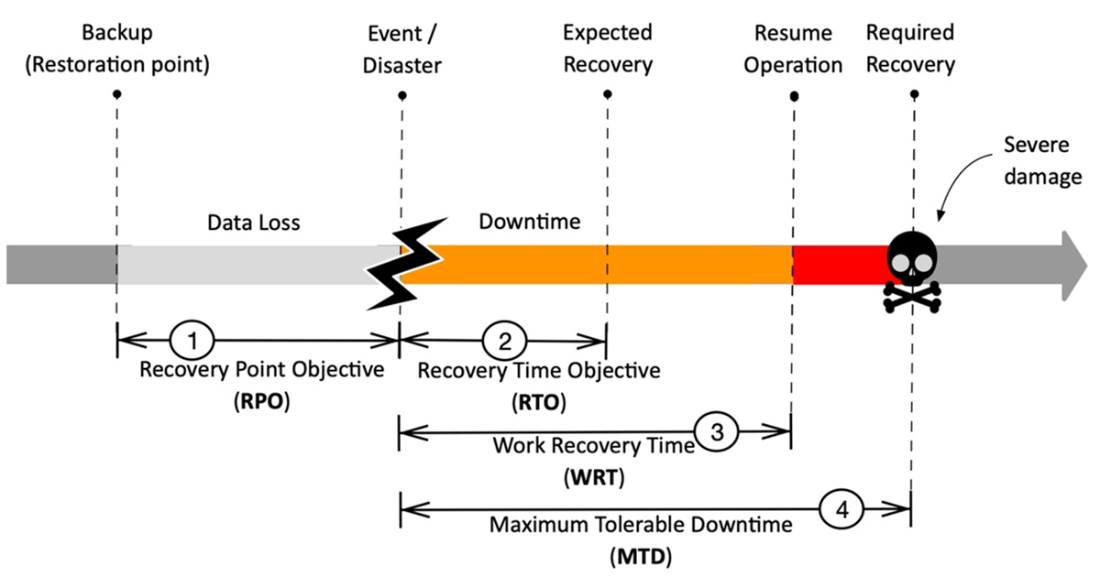
View how MTD relates to other recovery metrics over time. section 6.2


How Fundamentals of Cybersecurity covers it

How deep it goes
Defines MTD as a damage threshold and states that it equals RTO plus WRT.
Examples
Compares business functions using listed MTD values, including 72 hours for manufacturing and quality control.
What you can do after
Evaluate acceptable recovery targets and prioritize critical operations for continuity planning.
How it connects
Links MTD to business impact analysis, RTO, WRT, RPO, and business continuity planning.

Also explained in

Compare how 2 books explain maximum tolerable downtime →

Related concepts

This explainer was generated by Manning's knowledge graph from the text of Fundamentals of Cybersecurity. The section links point to the parts of the book it draws on.