When a user needs a human agent, a blind transfer makes them repeat themselves; passing the entire transcript leaves the agent searching while the user waits. A targeted conversation summary helps the agent continue from where the automated assistant stopped. section 12.0
A conversation summary gives just enough information to understand the interaction. It combines structured details with a short account of the conversation, tailored to what the receiving agent needs. section 12.1.2
Choose details for their usefulness to the agent, not simply because they were collected. A summary may include:
- Relevant identifiers, such as a member, provider, or claim ID. section 12.1.2
- Context gathered in the conversation or supplied from outside it. section 12.1.2
- A short account of the interaction and its outcome. section 12.1.2
Insurance claim handoff
A caller provides a provider ID, member ID, and date of birth, then asks about a claim. After finding the claim and giving its payment details, the assistant transfers the caller to a representative. The summary can record that the member was verified and include the provider, member, and claim IDs; the agent can retrieve further claim details using the claim ID. section 12.1.2
Figure 12.2 An effective summary pulls out key details from the conversation. Here it includes a summary of the conversation and the last claim searched. The AI portion of the call may have taken two minutes, but the human agent can read the summary in seconds.
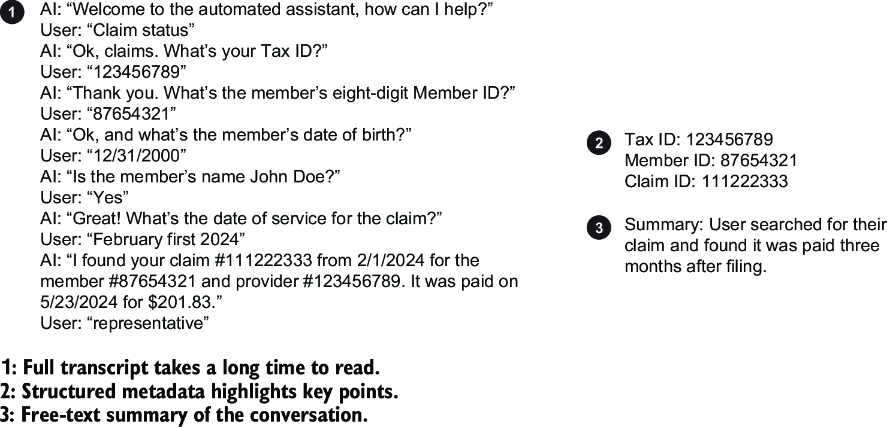
See how a short summary and the last claim searched can give an agent useful context at a glance. section 12.1.2

