A meta-learning system learns from many tasks so it can assemble a suitable model for a new task with very little data. section 19.4.7
Its long-term design combines reusable structures with search and abstraction:
- Stores recurring problem-solving patterns as reusable subroutines, functions, or classes in a global library. section 19.4.6 section 19.4.7
- Combines algorithmic blocks with geometric modules such as deep-learning components and pretrained representations. section 19.4.6 section 19.4.7
- Uses discrete program synthesis, guided by learned intuition, to search over combinations of reusable blocks. section 19.4.7
Reusable software components
An engineer who packages HTTP queries in R as a reusable library illustrates the intended pattern: solve a problem once, then adapt the stored solution to related tasks. section 19.4.6
Figure 19.16 A meta-learner capable of quickly developing task-specific models using reusable primitives (both algorithmic and geometric), thus achieving extreme generalization
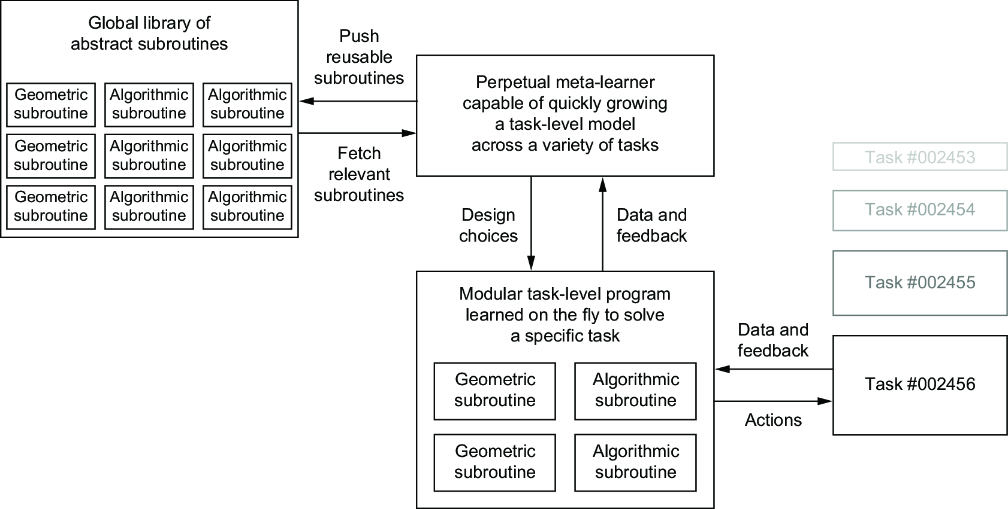
Shows a meta-learner assembling task-specific models from reusable algorithmic and geometric primitives. section 19.4.6
